.svg)

Search Engines: How They Work and How to Get Found
A search engine is the front door to the internet. Whether someone is hunting for an answer, a local service, or a brand they vaguely remember, their journey almost always starts with a query. If your content isn’t visible—or doesn’t satisfy that query—you are leaving traffic and revenue on the table.
To improve your presence without resorting to "keyword stuffing," you need to understand the mechanics of the system and the intent of the user.
1. How Search Engines Work (In Plain Language)
A search engine has one primary job: to provide the best possible answer to a user’s question. It achieves this through a continuous three-step cycle:
- Crawling: "Spiders" or "bots" scour the internet to find new or updated content.
- Indexing: The engine processes and stores that content in a massive database (the Index).
- Ranking: When a user types a query, the engine pulls the most relevant, high-quality results from its index and orders them.
The Goal: You aren't just "optimizing for Google"—you are optimizing for the system that decides if your page is the most helpful answer for a specific person.
2. Search Intent: The Secret to High Rankings
Even high-quality content will fail to rank if it doesn't match Search Intent. A search engine categorizes queries into four main buckets:
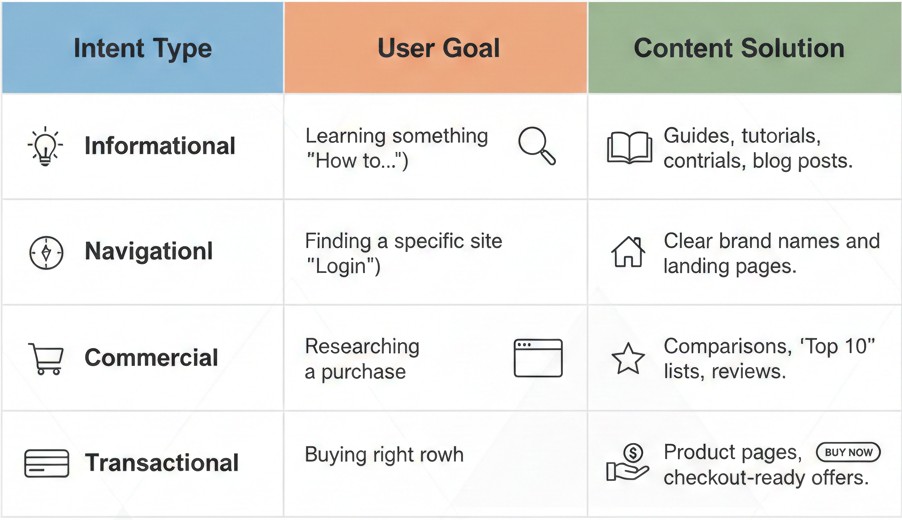
3. Building Trust and Authority
Search engines look for signals that your page is accurate and written by someone with real-world knowledge. This is often measured by the E-E-A-T framework:
- Experience: Does the content show first-hand involvement?
- Expertise: Is the author qualified to speak on this topic?
- Authoritativeness: Is your site a "go-to" source in your niche?
- Trustworthiness: Is the site secure, transparent, and cited by others?
Trust is reinforced by consistency. A site with 50 high-quality articles on one niche will almost always outrank a "thin" site that has one "perfect" post.
4. The Two Pillars of Visibility: On-Page and Technical
On-Page Essentials (The "What")
This is the part you control completely. Focus on making it easy for both humans and bots to understand your page:
- Header Tags (H1, H2, H3): Use these to create a logical outline.
- Natural Keywords: Include your main topic in the first paragraph and headers, but don't force it.
- Internal Linking: Link to your other relevant posts to keep users (and bots) on your site longer.
Technical SEO (The "How")
A search engine won't rank a site it can't read. Ensure your technical foundation is solid:
- Mobile-Friendliness: Most searches happen on phones; your site must look great on a small screen.
- Page Speed: If a site takes more than 3 seconds to load, users—and rankings—will drop.
- Secure Connection: Ensure you are using HTTPS.
5. Measure Success Beyond Rankings
Ranking #1 is great, but it’s a vanity metric if it doesn't lead to results. Track these instead:
- Organic Traffic: Are more people finding you over time?
- Click-Through Rate (CTR): Are your titles compelling enough for people to click?
- Conversion Rate: Is the traffic actually taking action (buying, signing up)?
Conclusion: Build for People, Signal for Systems
Search engines reward pages that satisfy intent, demonstrate expertise, and provide a smooth user experience.
When you focus on being helpful rather than "gaming the system," your visibility becomes a predictable outcome rather than a guessing game.