From SGE to AI Mode: how shopping on Google became generative
Last updated:
April 8, 2026
Author:
.svg)
For twenty years Google Shopping worked the same way. You typed a query, you got ten blue links and a few sponsored product cards. That model is now a leftover.
With AI Mode, Google treats every commercial question as a conversation. The user describes what they want in natural language, the AI interprets the intent, produces relevant visual content and shows shoppable products in a single flow. No click-outs, no side searches, no query reformulation. According to Google research carried out on 4,773 participants between October and December, AI Mode offers "a more helpful shopping experience when users can easily compare different brands and stores."
The shift started at the end of 2023 with SGE and consolidated over the following two years. Google rolled out AI Mode in more than 200 countries and territories, effectively renaming the entire generative search experience. A sign of how deep the transition goes comes from the numbers: EMARKETER estimates that 31.3% of the U.S. population will use generative search in 2026, while ChatGPT processes around 72 billion messages per month against Google's 417 billion searches. Google is still the giant, but conversational search is shifting the center of gravity.
Looking for a "metallic cherry-colored puffer jacket with wide pockets"? AI Mode generates photorealistic images matching the description, and below them shoppable real products pop up that visually match the generated image.
The benefit shows up most clearly in apparel. According to Google's internal data, 20% of apparel queries are five words or longer. These are exactly the descriptive queries where keyword search used to fall short and where generative AI shines.
Before, finding a product similar to an image meant a reverse image search or a new query. Today, under every generated (or displayed) image the cards of the real products that resemble it appear automatically, with price, seller, reviews and availability. The match is visual and semantic, so the quality of product images has become a de facto ranking factor.
Analyst Glenn Gabe also documented in March 2026 the appearance of new "Sponsored stores" and "Quick results from the web" units inside AI Mode, confirming that the interface keeps adding layers.
Virtual try-on started with women's tops, extended to men's tops with brands like Abercrombie, Banana Republic and J.Crew, and made the decisive leap with a feature that lets you upload your own photo and see how a garment picked from billions of listings looks on you. Google reported noticeably higher engagement on products with Try-On enabled: more time spent on the listing and a higher likelihood of click-through or purchase.
Two years ago Google took you to the product. Now Google buys it for you. Vidhya Srinivasan, VP and GM of Google Ads and Commerce, in her third annual letter to the advertising industry defined 2026 as the year "agentic commerce moves from concept to operational reality."
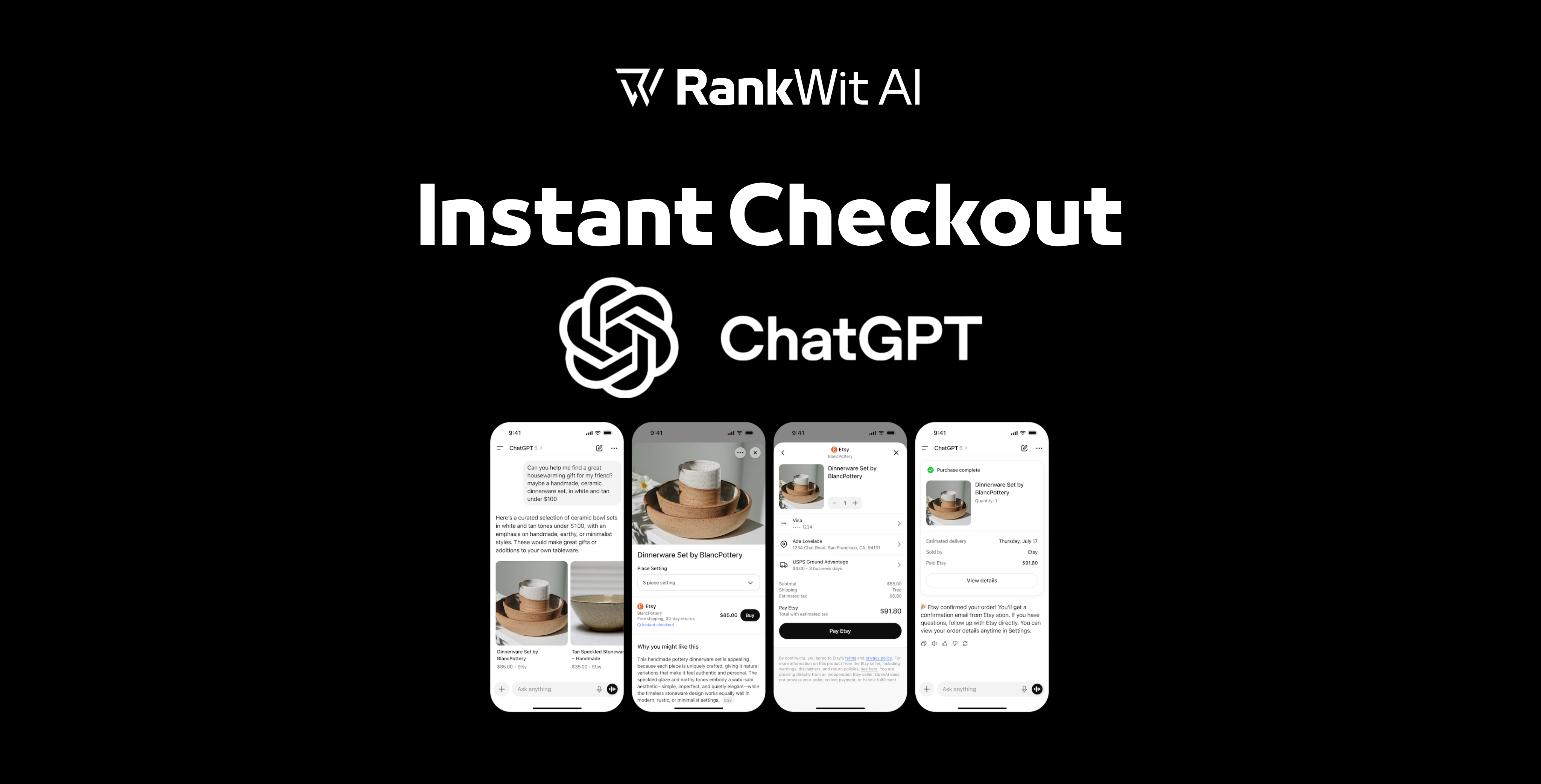
Worth noting that Google is not the only player on the field. OpenAI also integrated Instant Checkout inside ChatGPT, letting users complete a purchase without leaving the chat; for anyone selling online the question is how to plug in while there's still time, and the practical guide on how to enable Instant Checkout in ChatGPT is a solid starting point. The picture is clear: every major AI interface is building its own conversion channel.
You tap "track price" on a listing, set size, color and budget, and when the price drops Google adds the item to the merchant's cart and completes the checkout with Google Pay on your behalf. In January 2026 native checkout arrived directly inside AI Mode and the Gemini app, with Target, Etsy, Wayfair and other major retailers among the first partners. Walmart and Shopify are next.
Announced at NRF 2026, UCP is an open standard developed by Google with Shopify, Etsy, Wayfair, Target and Walmart, and backed by more than 20 other industry players including American Express, Mastercard, Stripe, Visa, Home Depot, Macy's and Zalando. It serves to let AI agents, retailers and payment processors speak the same language, without custom integrations for each individual agent. It's compatible with existing protocols like A2A, AP2 and MCP.
On the topic of protocols it's worth broadening the view. Alongside UCP, another standard is gaining ground, WebMCP, which is making the web navigable and usable directly by AI agents: the piece on how WebMCP is building the agentic web explains well why anyone running an e-commerce site should start thinking about their stack in "agent-first" terms.
For Shopify merchants UCP onboarding is automatic. If the catalog is already synced with Merchant Center, products become eligible for AI Mode, Virtual Try-On and agentic checkout without writing extra code. Google's official guide for merchants remains the reference for the minimum feed attributes.
Pilot launched in January 2026. Retailers can present exclusive discounts (say 20% off) directly inside AI Mode results, labeled as "Sponsored deal." First partners include Petco, e.l.f. Cosmetics, Samsonite and Rugs USA. In February 2026 Google extended the format with Shopping Ads inside AI Mode, which drop in during high-intent moments in the conversation.
A chat that puts the shopper in direct contact with the brand inside search, like a virtual sales associate trained on the retailer's own data. At launch Lowe's, Michael's, Poshmark and Reebok are already live, with further customization and agent-led checkout rolling out in the following months.
Here you need to look at the numbers without filters. A Seer Interactive study from September 2025 found a 61% drop in organic CTR for queries triggering AI Overviews, with paid CTR down 68%. A January 2026 analysis recorded that 93% of AI Mode queries produce no click to external sites.
But there's a second data point that shifts the picture. April 2026 research from Growth Memo shows that 88% of AI Mode users accept the AI's shortlist without external checks, compared to 56% in classic search who build their own shortlist. The AI's pick becomes the user's pick 74% of the time. Translation: traffic goes down, but the traffic that does come through converts better. Being cited by the AI is the new "first position on the SERP."
Add to that the fact that 20% of retail sales during the 2025 holiday season were attributed to AI, according to Salesforce, and that referral traffic from AI tools to retail sites was already growing over 1,200% year on year according to Adobe Analytics. The volumes are still small in absolute terms, but the curve is too steep to be ignored.
The most common mistake is treating these developments as "one more channel." They are not. They are the infrastructure where a growing share of online transactions will happen.
Here are five concrete priorities.
Merchant Center feed always clean and complete. Descriptive titles, structured attributes, prices and availability kept up to date. If a product is not in the Shopping Graph, for the AI it does not exist.
High-resolution product images, consistent backgrounds, accurate rendering of color and texture. The matching engine is visual, so mediocre photos translate into invisibility.
Category copy and descriptions that mirror natural language. "Gift for someone who loves making fresh pasta" works better than "premium kitchen utensils." LLMs reward the way real people actually talk, and those long queries are exactly the ground where generative AI performs best.
Content with a GEO mindset. According to a Growth Memo analysis, 4.8% of the URLs most cited by ChatGPT are in-depth content that answers "what is it," "who uses it," "how to choose" and "how much does it cost" all in a single page. Building complete guides with verifiable facts boosts the citation rate, which is the new KPI of visibility.
Separate tracking of AI referral traffic. Segment it in analytics, figure out which SKUs are being surfaced and optimize accordingly. Anyone waiting for it to become "significant" will arrive late. Also worth noting that AI citations are less stable than traditional ranking: between 40% and 60% of cited sources change month over month in Google AI Mode and ChatGPT.
In just over two years commercial search on Google has changed at the root: SGE became AI Mode, the Shopping Graph passed the 50 billion listings mark, the experimental Virtual Try-On became native agentic checkout inside Gemini, and UCP is trying to do for agentic commerce what HTTP did for the web.
For the shopper the result is less friction between desire and purchase. For the retailer the message is less comfortable: the first interaction with the customer might no longer happen on the product page of their own site, but inside a conversation with an AI agent, whether that's Gemini, ChatGPT or a third-party agent built on WebMCP. Brainlabs' Dan Connor put it well: "if your product data isn't agent-readable, you're invisible". Those who structure their data today to be readable by those agents will have the edge in the next 12-24 months. The others will simply stay off the radar.
Google's Generative AI Shopping is a set of capabilities within Google's Search Generative Experience (SGE) that transforms product discovery from a keyword-based process into a visual, conversational one.
Instead of scrolling through pages of blue links, users can now:
This approach is particularly powerful for apparel and fashion, where traditional keyword search often fails to capture the specificity of what a shopper has in mind. According to Google's internal data, 20% of apparel queries are five words or longer, a type of search that generative AI handles far more effectively than conventional engines.
Why it matters for GEO: Content and product listings that are well-structured, semantically rich, and paired with high-quality imagery are more likely to be surfaced in these AI-generated shopping results. Optimizing for this new discovery layer is now a core part of any AI visibility strategy.
The "Shop Similar" feature is one of the most commercially significant additions to Google's Search Generative Experience. It bridges the gap between inspiration and purchase in a single, seamless flow.
Here's how it works:
The user never needs to reformulate their query, run a reverse image search, or navigate to a separate shopping tab. The entire journey, from idea to purchasable product, happens within the search interface.
Key distinction: The matching logic is visual and semantic, not purely keyword-driven. This means that the quality and accuracy of product imagery now plays a direct role in whether a product appears in these AI-matched results.
What this means for retailers: Products that are well-represented in Google's Shopping Graph, with accurate metadata, competitive pricing, and high-resolution imagery, are far more likely to be surfaced. Brands that invest in structured product data and visual quality will have a measurable advantage in this new shopping experience.
Google's AI-powered Virtual Try-On is a Google Shopping feature that uses generative AI to show how a specific garment looks on a real model matching the shopper's preferences.
Users can choose from 40 models varying in:
This helps shoppers make more confident purchase decisions without visiting a physical store, solving one of the biggest friction points in online apparel shopping: uncertainty about fit and appearance.
Google reported that products with Virtual Try-On enabled received significantly higher quality engagement, meaning shoppers spent more time interacting with those listings and were more likely to take actions such as clicking through or completing a purchase.
As Google extends Virtual Try-On to additional categories, brands that participate in the program and provide standardized, high-quality product images will benefit from stronger engagement signals and greater conversion potential. This feature is a clear indicator that visual content quality is becoming a ranking factor in AI-powered shopping experiences.
Google's Generative AI Shopping features are redefining the journey from product discovery to purchase. For retailers and marketers, this demands a strategic shift across several areas.
With AI-powered "Shop Similar" product matches based on visual and semantic similarity rather than keywords alone, product image quality has never mattered more. Low-resolution photos, inconsistent backgrounds, or images that don't accurately represent the product will be at a disadvantage.
Best practice: Use clean, high-resolution product photography. Make sure images accurately represent colors, textures, and proportions, as the AI matching engine evaluates these attributes directly.
Google's Shopping Graph — a continuously updated dataset of over 35 billion product listings — is the backbone of every AI-powered shopping feature. Incomplete, outdated, or missing products simply won't surface in AI-generated results.
Best practice: Keep product feeds up to date with accurate titles, descriptions, prices, availability, and structured attributes. Treat Shopping Graph as critical infrastructure, not a secondary operation.
As users learn to describe products in natural language (e.g., "gifts for a 7-year-old who wants to be an inventor"), search behavior will shift toward longer, more descriptive queries. These are exactly the kind of queries generative AI excels at interpreting.
Best practice: Write product descriptions and category content that mirrors how real people talk about your products. Focus on use cases, scenarios, and specific attributes rather than generic marketing copy.
According to Adobe Analytics, traffic from generative AI tools to retail websites grew 1,200% year over year in early 2025, with visitors showing longer sessions, more page views, and lower bounce rates. While still a small share of total traffic, the growth trajectory is steep.
Best practice: Track AI-referred traffic as a distinct channel in your analytics. Identify which products and categories are being surfaced by AI tools and optimize accordingly.
The shift from keyword search to AI-powered generative search is not a future event, it's happening now. Retailers who adapt their product data, visual assets, and content strategy today will be positioned to capture the growing share of purchase intent driven by AI-powered discovery.