How WebMCP is Building the Agentic Web
Last updated:
February 20, 2026
Author:
.svg)
Today’s AI agents often "fly blind." To interact with a website, they must guess how a page works by scraping raw HTML, analyzing screenshots, or simulating trial-and-error clicks.
This process is slow, fragile, and breaks the moment a developer changes a CSS class.
WebMCP (Web Model Context Protocol) changes this paradigm. It introduces a standardized method for websites to expose structured tools directly to AI agents. Instead of guessing, agents now know exactly which actions are available and how to execute them with surgical precision.
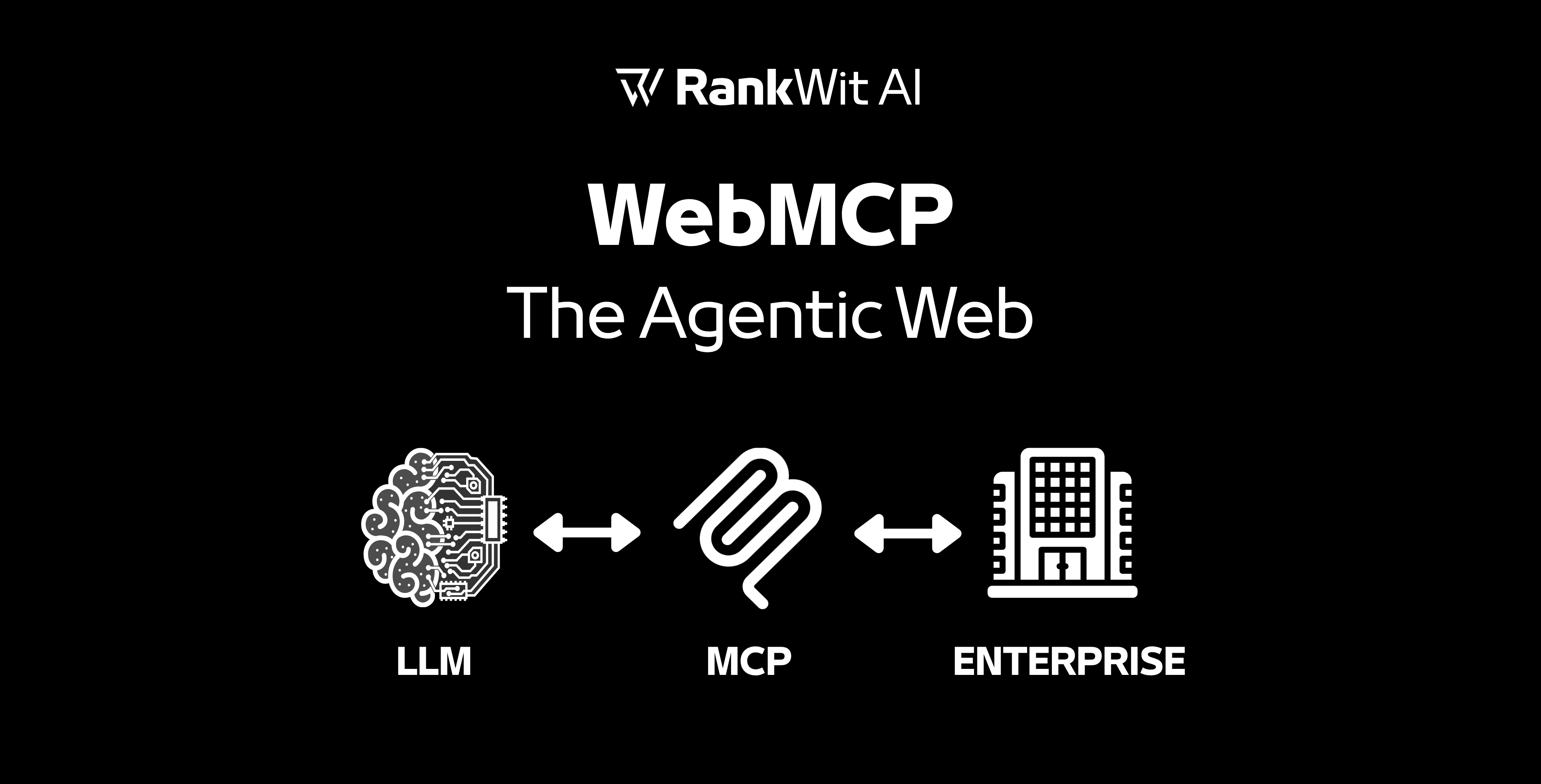
At its core, WebMCP is a server protocol that acts as the "connective tissue" between Large Language Models (LLMs) and the live web.
According to the Chrome Developer team, it provides a structured communication layer that moves beyond simple API calls.
By creating a bidirectional channel, WebMCP allows an LLM to request specific data or trigger actions in real-time. T
his infrastructure is the backbone of modern Retrieval-Augmented Generation (RAG) and the next generation of tool-augmented search engines.
WebMCP operates on a high-performance client-server model:
The protocol uses a streamlined JSON request-response pattern. The AI sends a tool call (e.g., "Check flight availability"), and the server returns a structured response. This design prioritizes low latency, ensuring that AI-driven search remains snappy and responsive.
WebMCP transforms search from keyword matching into goal-oriented task completion. Instead of just answering a question, an AI powered by WebMCP can act as a research assistant:
Historically, developers had to hardcode every single API integration for an AI, a brittle, manual process.
WebMCP inverts this through Dynamic Discovery.
In this new model, the server declares its capabilities and schemas. The LLM then dynamically decides which tools to use based on the user's current goal. This abstraction allows developers to update data sources or tools without ever touching the core AI prompts.
To accelerate adoption, Google Chrome Labs has released the webmcp-tools repository. This toolkit provides the "scaffolding" to turn any website into a client-side MCP server.
Developers can expose their application logic using two distinct methods:
<form> tags with toolname and tooldescription. The browser automatically translates these into machine-readable schemas.registerTool() function via the navigator.modelContext API to define complex logic and custom JSON schemas.The toolkit features Tab and Extension Transports, enabling AI agents to interact with a site within a user's authenticated session. Crucially, this follows a "human-in-the-loop" philosophy: actions require user consent, ensuring privacy and security remain the top priority.
WebMCP is helping transition the web from a collection of visual pixels into a programmable, high-accuracy database for intelligent agents. Whether it is a research assistant synthesizing scientific reports or an e-commerce agent managing a complex checkout, WebMCP provides the "handshake" that makes it possible.
Ready to start building? You can explore the WebMCP-tools GitHub to find React and Vanilla TypeScript demos that bring these "agentic" capabilities to life.
While traditional scraping is fragile and prone to breaking when a website's design changes, WebMCP provides a reliable "handshake" between the site and the AI.
Security is baked into the protocol's core. Unlike "headless" automation, WebMCP operates within the user’s current browser session:
webmcp-tools suite.
We are moving from a web of pixels to a web of actions.
Agentic RAG represents a new paradigm in Retrieval-Augmented Generation (RAG).
While traditional RAG retrieves information to improve the accuracy of model outputs, Agentic RAG goes a step further by integrating autonomous agents that can plan, reason, and act across multi-step workflows.
This approach allows systems to:
In other words, Agentic RAG doesn’t just provide better answers, but it strategically manages the retrieval process to support more accurate, efficient, and explainable decision-making.
Traditional LLMs are limited by their training data "cutoff" dates. WebMCP bridges this gap by enabling Dynamic Context Injection:
Implementing WebMCP is streamlined through the Google Chrome Labs toolkit. Developers have two primary paths:
toolname and tooldescription attributes to existing HTML <form> tags.navigator.modelContext.registerTool() API to expose complex JavaScript functions as callable AI tools.This flexibility allows teams to start with basic functionality and scale to complex integrations without a total architecture overhaul.