You can let ChatGPT users buy from your store without leaving the conversation. That is what Instant Checkout does, and it runs on a public specification you can implement today. This guide walks through the three layers you need: a structured product feed, the Agentic Checkout API, and delegated payments. Expect real engineering work, but nothing exotic: REST endpoints, webhooks, and a payment provider you probably already use.
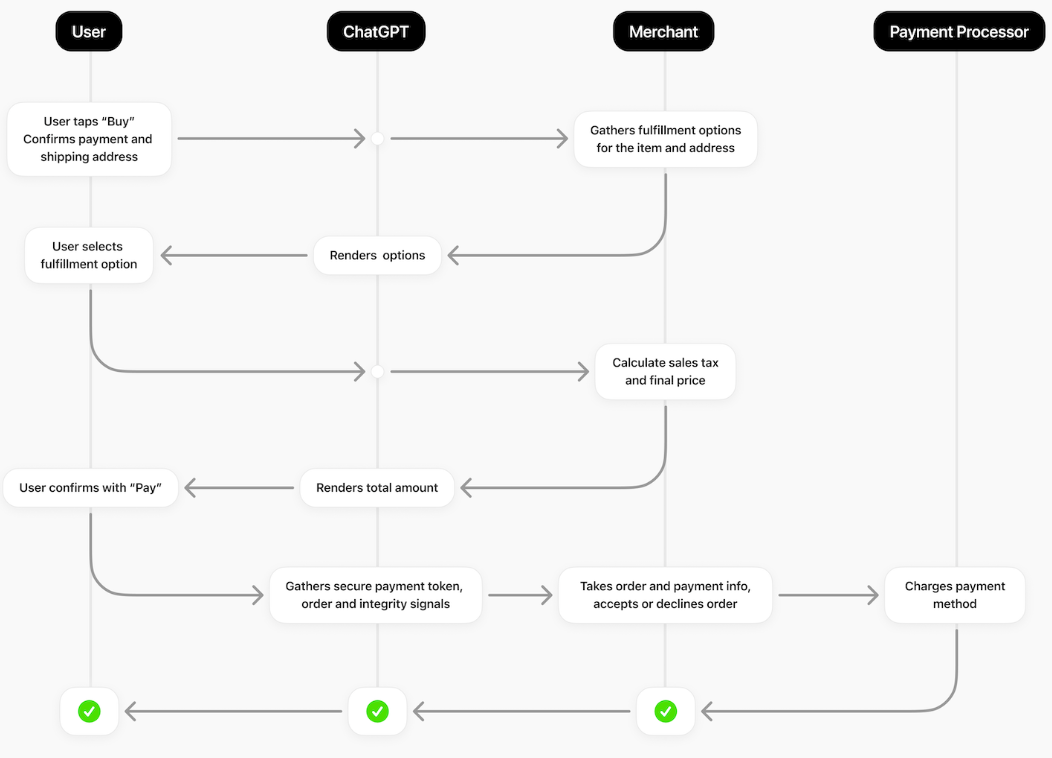
Instant Checkout is the purchase flow built on OpenAI's Agentic Commerce Protocol (ACP) that lets a shopper complete an order inside ChatGPT, while your store keeps processing the payment and owning the order. ChatGPT handles discovery and the conversation; your systems handle inventory, checkout, and fulfillment.
One caveat before the steps: Instant Checkout is currently available for U.S.-based e-commerce only. If you sell elsewhere, treat this as preparation time rather than lost time.
Step 1: build the product feed
The feed is how ChatGPT learns what you sell. It provides the structured data the model uses to find, display, and manage your products when a user asks for something.
OpenAI publishes a detailed product feed specification supporting TSV, CSV, JSON, and XML. Pick whichever format your stack already produces, then match the schema exactly.
The feed covers these data categories:
- OpenAI flags: visibility settings that decide whether a product can be found and whether it is eligible for checkout.
- Core product data: title, description, URL, merchant product ID, GTIN, and MPN.
- Item attributes: brand, category, condition, dimensions.
- Media: up to two images, one video URL, one 3D model URL.
- Price and promotions: base price, discounts, promotional pricing.
- Availability and variants: real-time stock, pickup options, color and size variants.
- Fulfillment and merchant info: shipping options and costs by region, business name, privacy and return policies.
- Compliance, reviews, and Q&A: legal disclaimers, minimum age requirements, optional structured reviews.
Freshness is a hard requirement, and 15 minutes is the number to remember. OpenAI expects feeds to refresh at least that often, so price, stock, and promotions stay current. A stale feed means wrong prices and failed checkouts, exactly the experience that kills trust in conversational buying.
Step 2: implement the Agentic Checkout API
Once a product is discoverable, ChatGPT manages the transaction through the Agentic Checkout API, defined in the Agentic Commerce Protocol. Your side of the contract is five REST endpoints covering the checkout lifecycle:
- POST /checkout_sessions creates a session with the initial cart and customer data.
- POST /checkout_sessions/{checkout_session_id} updates the session when items, quantities, or addresses change.
- GET /checkout_sessions/{checkout_session_id} returns the current session state.
- POST /checkout_sessions/{checkout_session_id}/complete finalizes the order and captures payment data.
- POST /checkout_sessions/{checkout_session_id}/cancel cancels the session.
Every endpoint speaks HTTPS and JSON, carries standardized headers (bearer tokens, timestamps, request IDs), and needs idempotency plus structured error handling. Build the error paths carefully. An AI agent retries more mechanically than a human ever would.
Keep orders in sync with webhooks
Two webhook events keep ChatGPT's view of the order aligned with yours:
- order_created fires when the order is successfully placed.
- order_updated fires on status changes such as shipped, fulfilled, or refunded.
Sign each webhook with the HMAC-based scheme in the spec, so both systems can verify authenticity and integrity.

Step 3: connect delegated payments
The payment layer runs through a payment service provider (PSP) under ACP's Delegated Payment Specification. OpenAI and Stripe currently support this model through the Stripe ACP implementation.
The principle is simple: neither ChatGPT nor your store ever touches raw card data. The PSP stores, tokenizes, and authorizes credentials, keeping the flow compliant with PCI DSS Level 1. Where Strong Customer Authentication applies, 3D Secure verification is supported. Authorizations and settlements run through the PSP's sandbox or production environment, depending on your deployment stage.
For you, this cuts the integration surface sharply. Payment security stays with a provider whose whole business is payment security.

Step 4: validate end to end
A typical rollout follows this order:
- Map your catalog to OpenAI's schema and automate the refresh cycle.
- Develop the five checkout endpoints and the webhook logic.
- Connect the PSP and test delegated token flows in sandbox.
- Simulate complete transactions: product selection, checkout, payment, confirmation, and cancellation paths.
Do not skip the cancellation and refund paths. Conversational buyers change their minds mid-chat, and the agent needs a clean way to unwind a session.
Do you even need a custom integration?
It depends on your platform:
- Shopify and Etsy merchants already benefit from ChatGPT's Instant Checkout without extra integration work.
- Custom and enterprise platforms need to build the three layers above: feed, checkout API, and delegated payments.
We build these integrations at RankWit, from feed management to payment orchestration. But we tell every merchant the same thing first: checkout is the last mile. It only pays off if ChatGPT surfaces your products at all, which is a visibility problem before it is an engineering one. Our breakdown of how ChatGPT chooses its sources explains that selection layer, and our guide to agentic engine optimization (AEO) covers preparing for AI agents beyond a single platform. To see where your store stands today, RankWit include AI visibility monitoring across ChatGPT, Perplexity, Gemini, Claude and Grok.
FAQ
Is Instant Checkout available outside the United States?
Not yet. The program currently covers U.S.-based e-commerce. OpenAI has not published an expansion timeline, so merchants elsewhere should use the time to prepare their feed and checkout infrastructure, which is the slow part of the work anyway.
Does ChatGPT see my customers' card data?
No. Under the Delegated Payment Specification, the PSP stores and tokenizes payment credentials. ChatGPT and the merchant exchange secure tokens, never raw card numbers, and the flow stays compliant with PCI DSS Level 1. 3D Secure is supported where regulations require it.
I sell on Shopify. Do I need to build anything?
No. Shopify and Etsy merchants are covered without additional integration effort. Your practical work moves upstream: keep product data clean and complete, because discovery inside ChatGPT depends on the quality of the catalog data the model receives.
How often does my product feed need to refresh?
At least every 15 minutes, per OpenAI's requirements for commerce partners. That cadence keeps prices, stock levels, and promotions accurate at the moment a shopper confirms a purchase inside the conversation.