Retrieval-Augmented Generation is the reason an AI assistant can quote a page published yesterday even though its training ended months earlier. Instead of answering from memory alone, the model first fetches relevant documents and reads them. That fetch step has a direct commercial consequence: if the AI retrieves your page, it can cite you. If it does not, you are absent from that answer, whatever your brand is worth.
Retrieval-Augmented Generation (RAG) is a technique that retrieves relevant documents from an external knowledge source and injects them into a language model's context before it generates an answer.
The approach was introduced in 2020 and has moved from research prototype to standard practice in enterprise AI. It addresses three structural weaknesses of a standalone LLM:
- Accuracy. Grounding output in retrieved evidence reduces hallucinations.
- Freshness. The model can use data published after its training cutoff.
- Explainability. Retrieved sources are traceable, so answers can be verified.
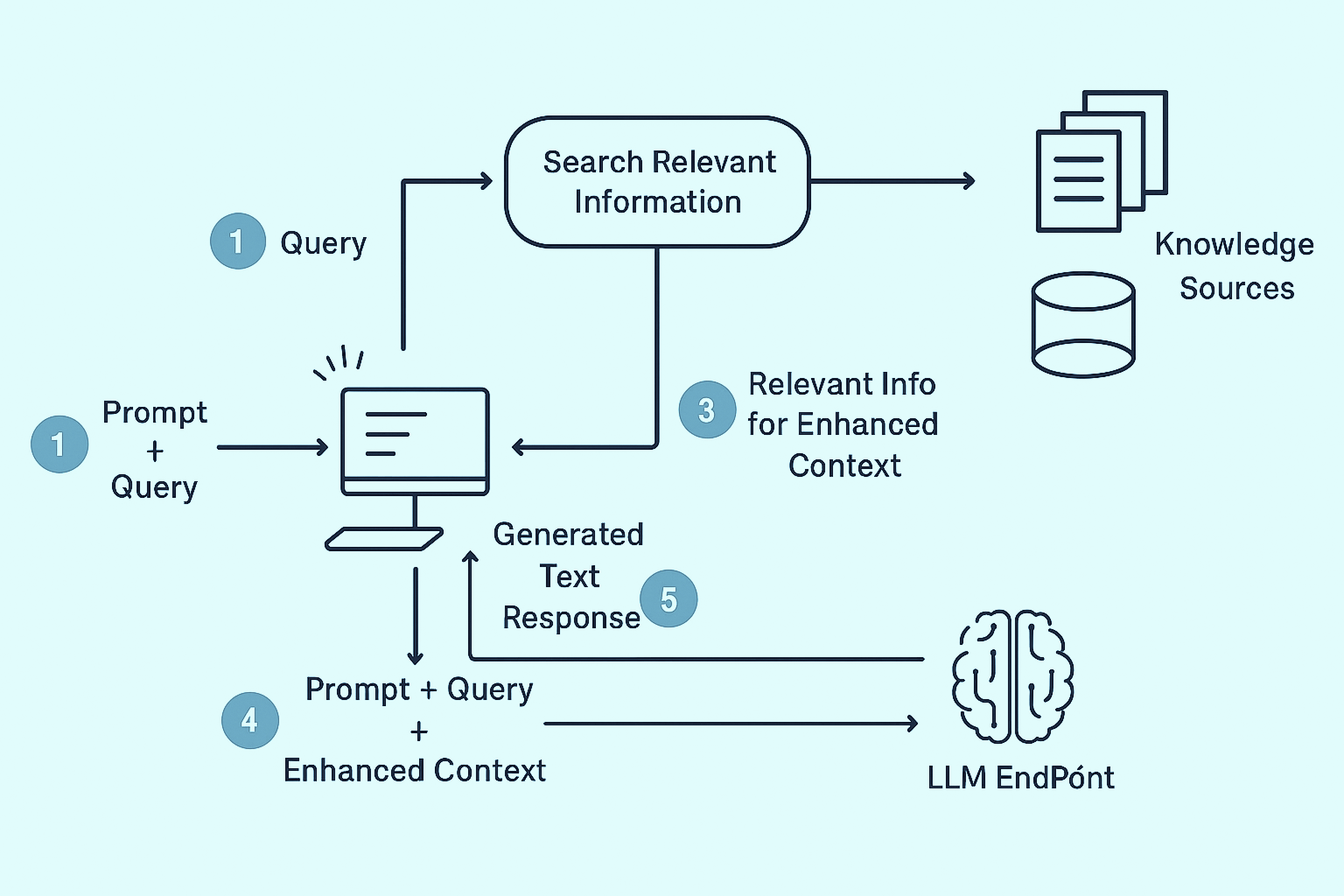
How does a RAG system work?
- The user's question is converted into a searchable representation, typically an embedding vector.
- A retriever searches a knowledge source (a vector database, a document store, or the live web) and returns the most relevant passages.
- Those passages are injected into the model's context window alongside the original question.
- The model generates an answer grounded in the retrieved material, often citing the sources it used.
Researchers presenting at EMNLP 2024 describe RAG as a design space rather than a single method: every stage, from chunking to retrieval strategy to reranking, can be tuned for the task at hand. Their paper, Searching for Best Practices in Retrieval-Augmented Generation, maps which combinations work best.
Two design choices matter more than the rest. Chunking decides how documents get split into retrievable passages: chunks that are too long dilute relevance, while chunks that are too short lose context. The retriever itself can be dense, based on embedding similarity, or sparse, based on keyword matching; many production systems combine both and add a reranking step that reorders candidates before they reach the model.
What is new in RAG research?
Since 2024 the research has branched in several directions:
- GraphRAG, from Microsoft Research, adds knowledge graphs to the retrieval pipeline so the model can follow relationships between entities. That helps in compliance, fraud detection, and scientific work.
- MiniRAG adapts retrieval for small language models, making RAG viable on edge devices and in low-resource deployments.
- VideoRAG extends retrieval to video, combining visual embeddings with textual metadata to find relevant segments.
- SafeRAG benchmarks security, stress-testing pipelines against data leakage, prompt injection, and adversarial manipulation.
- Agentic RAG puts retrieval inside multi-step agent workflows, where a model plans, retrieves, and acts in sequence.
How do teams run RAG in production?
Four open-source frameworks cover most implementation work:
- LangChain, the broadest toolset, with LangSmith for debugging.
- LlamaIndex, focused on connecting LLMs to private and structured data, with over 300 integrations.
- Haystack, modular pipelines with a visual builder aimed at enterprise teams.
- LightRAG, a lightweight implementation built for speed.
For a hands-on start, Hugging Face publishes a RAG from scratch tutorial. On the storage side, common choices include Pinecone, Weaviate, Milvus, and pgvector, which differ mainly in scale, hosting model, and cost.
Industry observers converge on two points. Squirro argues that RAG has become the backbone of enterprise knowledge management. TechRadar adds that retrieval delivers most of its value when paired with solid document management and metadata search. Sloppy inputs produce sloppy retrieval, whatever the model.
Evaluation has matured too. RAGEval generates domain-specific test datasets, RAGBench offers 100,000 examples across five industries, and Microsoft's BenchmarkQED automates stress-testing for retrieval pipelines.
Why does RAG decide your AI visibility?
Every consumer answer engine is RAG at web scale. ChatGPT with search, Perplexity, Gemini, and Google's AI Overviews all retrieve live pages before generating, then cite a subset of what they retrieved.
That changes what visibility means. A model's training data is frozen; retrieval is not. If your page is crawlable, clearly structured, and answers a question directly, it can be retrieved today and cited today. If retrieval skips you, the assistant recommends someone else.
Three practical moves follow:
- Let AI crawlers in. GPTBot, PerplexityBot, and ClaudeBot obey robots.txt; blocking them removes you from retrieval.
- Make pages quotable. Direct definitions and clear headings survive the passage-selection step, the same mechanics we describe in how ChatGPT chooses its sources.
- Point models at your best content with an llms.txt file.
The same logic runs inside the answers your prospects read. Ask an assistant which vendors to consider in your category, and the names it lists come from the pages its retrieval step surfaced seconds earlier. Nothing about the brand mattered in that moment; what mattered was which pages made it into the context window.
Understanding how the underlying models work makes the pattern obvious: a system that predicts from context will cite whatever fills that context. We built RankWit to monitor which pages actually get retrieved and cited across engines.
FAQ
Does ChatGPT use RAG?
Yes, whenever it searches the web. ChatGPT with browsing or search retrieves pages in real time, injects them into context, and answers with citations, which is RAG applied to the open web. Without search, it answers purely from parameters learned during training, so responses may be outdated and carry no sources.
What is the difference between RAG and fine-tuning?
Fine-tuning changes the model's weights with additional training, baking knowledge in; it is slow, costs money per iteration, and goes stale. RAG leaves the model untouched and supplies knowledge at question time, so updating your data means updating the documents in the retrieval index. Many production systems combine both.
What is a vector database?
A vector database stores embeddings, numerical representations of text, and finds the entries closest in meaning to a query rather than only those sharing keywords. It is the retrieval layer of most RAG systems. Pinecone, Weaviate, Milvus, and pgvector are common choices, differing mainly in scale, hosting model, and cost.
Can RAG still hallucinate?
Yes, though less often. Grounding answers in retrieved documents cuts fabrication substantially, but the model can misread a source, blend two passages incorrectly, or fall back on parametric memory when retrieval returns nothing useful. Benchmarks like RAGBench and SafeRAG exist precisely because grounded systems still need verification.