What technical elements are most important when optimizing a website for AI-driven search engines?

To optimize for AI-driven search, websites need clear technical foundations such as structured data, clean site architecture, fast loading times, and accessible content. These elements help search engines and AI models process and interpret the information more effectively.

Last updated at  
April 13, 2026
Other FAQ
Why does GEO matter now?
Arrow

Generative Engine Optimization (GEO) is becoming increasingly critical as user behavior shifts toward AI-native search tools like ChatGPT, Gemini, and Perplexity.
According with Bain, recent data shows that over 40% of users now prefer AI-generated answers over traditional search engine results.
This trend reflects a major evolution in how people discover and consume information.

Unlike traditional SEO, which focuses on ranking in static search results, GEO ensures that your content is understandable, relevant, and authoritative enough to be cited or surfaced in LLM-generated responses.
This is especially important as AI platforms begin to integrate live web search capabilities, summaries, and citations directly into their answers.

The urgency is amplified by user traffic trends. According to Similarweb data (see chart below), ChatGPT visits are projected to surpass Google’s by December 2026 if current growth continues.
This suggests that visibility in LLMs may soon be as important—if not more—than traditional search rankings.

Projection based on traffic from the last 6 months (source: Similarweb US).

Read More
ArrowArrow right blue
How can businesses use industry case studies to improve their own AI search and SEO strategies?
Arrow

By analyzing industry case studies, businesses can learn from proven strategies, understand emerging trends, and identify opportunities to improve their own digital presence. These insights help companies make more informed decisions when adapting to AI-powered search environments.

Read More
ArrowArrow right blue
What is tokenization, and why does it matter for GEO?
Arrow

Tokenization is the process by which AI models, like GPT, break down text into small units—called tokens—before processing. These tokens can be as small as a single character or as large as a word or phrase. For example, the word “marketing” might be one token, while “AI-powered tools” could be split into several.

Why does this matter for GEO (Generative Engine Optimization)?

Because how well your content is tokenized directly impacts how accurately it’s understood and retrieved by AI. Poorly structured or overly complex writing may confuse token boundaries, leading to missed context or incorrect responses.

Clear, concise language = better tokenization
Headings, lists, and structured data = easier to parse
Consistent terminology = improved AI recall

In short, optimizing for GEO means writing not just for readers or search engines, but also for how the AI tokenizes and interprets your content behind the scenes.

Read More
ArrowArrow right blue
How often does RankWit update AI visibility data?
Arrow

RankWit refreshes your AI visibility data every 24 hours by default, ensuring you always have an accurate and up-to-date picture of how your brand appears across major AI platforms.

On top of this, depending on your plan:

  • Starter: Daily updates
  • Growth: Daily updates + priority refresh cycles
  • Enterprise: Real-time or custom-scheduled updates, ideal for large teams and high-volume monitoring needs

This update frequency ensures you can quickly spot changes in rankings, sentiment shifts, and competitor activity—allowing your team to respond proactively and maintain strong AI visibility.

Read More
ArrowArrow right blue
What makes AI search optimization different from traditional SEO strategies for B2B companies?
Arrow

Traditional SEO often focused heavily on keyword targeting and ranking pages in search results. AI-driven search, however, prioritizes context, expertise, and relationships between entities. For B2B companies, this means creating deeper, more authoritative content that AI systems can trust and reference when generating answers.

Read More
ArrowArrow right blue
What key factors help content perform well in generative search engines and AI answer systems?
Arrow

Content that performs well in generative search environments is usually well-structured, informative, and built around clear topics and entities. Providing reliable information, logical content organization, and strong authority signals helps AI systems understand and reference the content more effectively.

Read More
ArrowArrow right blue
What trends will shape the next generation of LLM optimization strategies?
Arrow

Future LLM optimization strategies will focus on semantic understanding, strong entity signals, structured knowledge, and high-quality information sources. These trends will help AI systems deliver more accurate and context-aware responses.

Read More
ArrowArrow right blue
How are large language models used in modern search engines, digital platforms, and AI-powered applications?
Arrow

Large language models power many modern technologies, including AI assistants, conversational search systems, automated content generation, and customer support tools. Their ability to interpret natural language allows digital platforms to deliver more intelligent and interactive experiences.

Read More
ArrowArrow right blue
How can Rankwit help my business integrate with ChatGPT’s Agentic Commerce Protocol?
Arrow

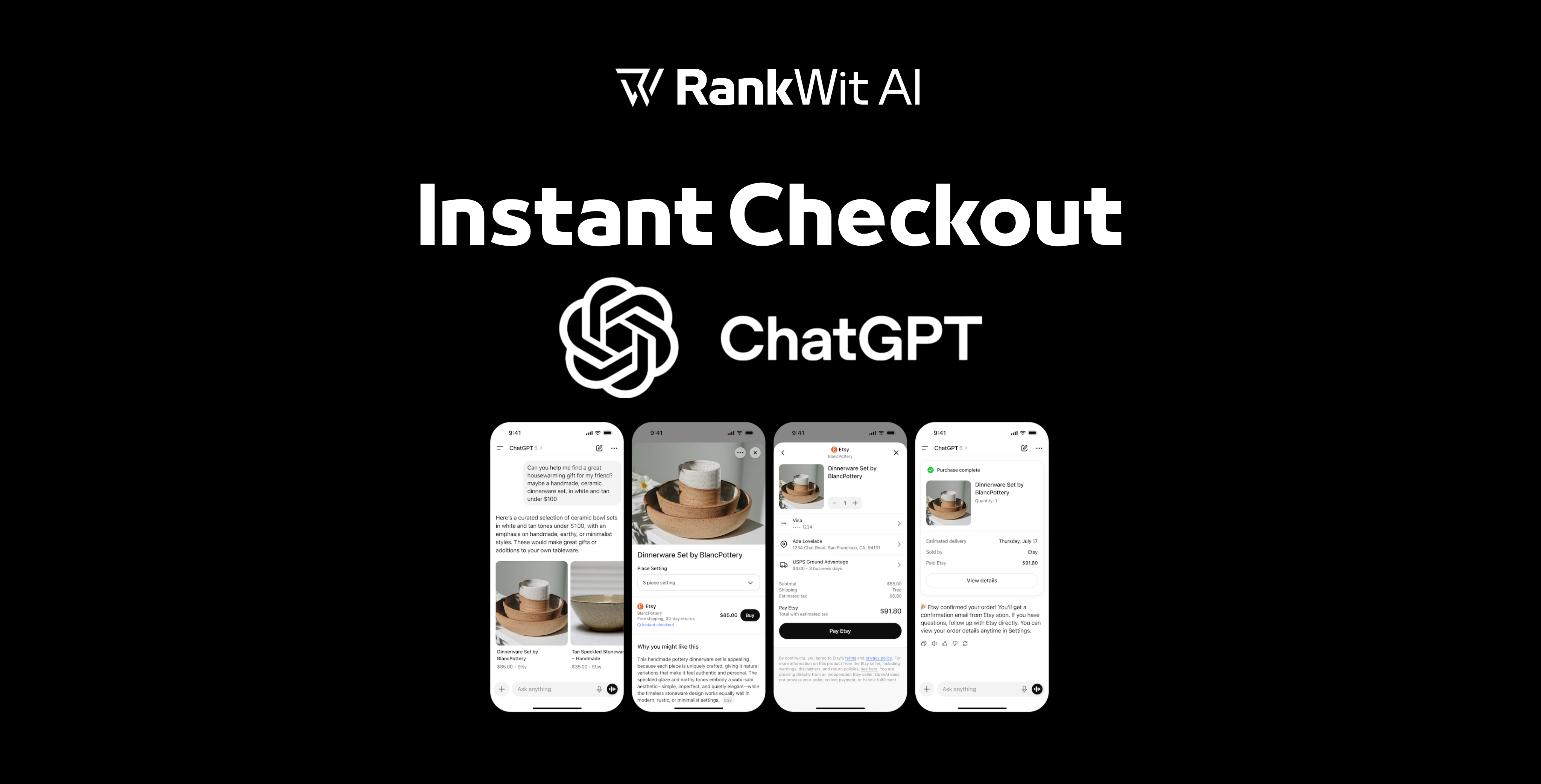
At Rankwit, we specialize in helping merchants take advantage of OpenAI’s Agentic Commerce Protocol (ACP).
Our team manages the entire integration lifecycle, from mapping your product catalog to OpenAI’s structured feed specification, to building the checkout API endpoints and connecting secure payment providers like Stripe.

By partnering with Rankwit, your business can:

  • Launch AI-powered conversational shopping experiences inside ChatGPT.
  • Achieve full compliance with OpenAI and PCI DSS standards.
  • Gain an unfair competitive advantage by adopting this technology before it becomes mainstream.

We tailor solutions to both enterprise and custom e-commerce platforms, ensuring a scalable and future-ready architecture.

Read More
ArrowArrow right blue
Why are industry case studies important for understanding how AI-driven search and SEO strategies work in real-world scenarios?
Arrow

Industry case studies provide real-world examples of how SEO, AI search optimization, and digital strategies perform across different sectors. They help businesses understand what works, what challenges may arise, and how similar organizations have improved their search visibility and online performance.

Read More
ArrowArrow right blue