Can I cancel my subscription at any time?

Yes. You can cancel your subscription, downgrade, or upgrade your plan at any time.

Last updated at  
November 24, 2025
Other FAQ
How are RankWit credits calculated?
Arrow

Credits determine how much AI tracking you perform.
A single credit = 1 prompt × 1 AI model.

For example:

  • 10 prompts
  • × 3 AI models (ChatGPT, Google AI Overview, Perplexity)
    = 30 credits

This transparent system ensures you only pay for the tracking you use.

Read More
ArrowArrow right blue
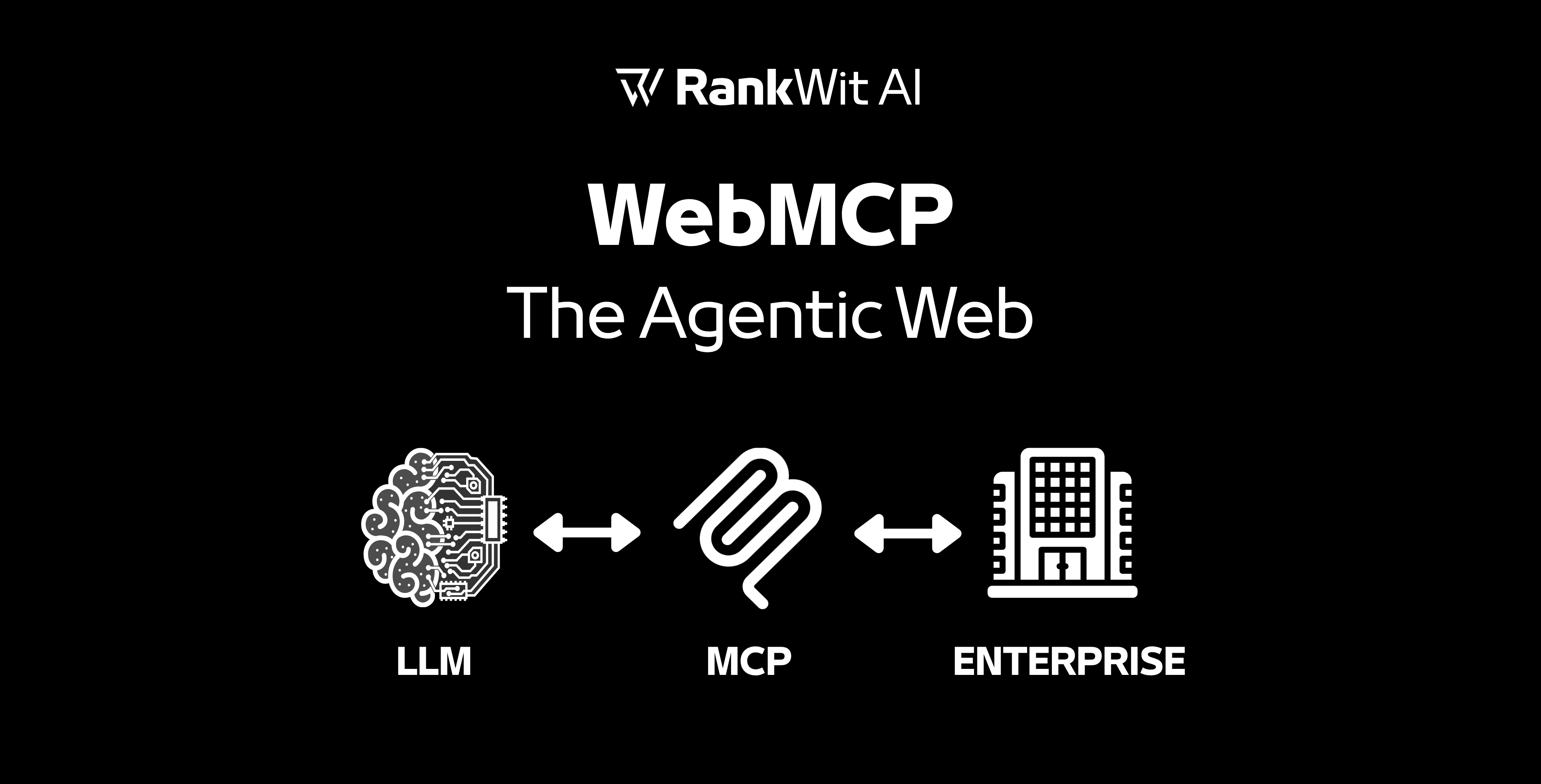
How does WebMCP differ from traditional web scraping when AI agents interact with websites?
Arrow

While traditional scraping is fragile and prone to breaking when a website's design changes, WebMCP provides a reliable "handshake" between the site and the AI.

  • Direct Access: Agents call specific functions (tools) instead of searching for buttons in code.
  • Resilience: Site layout changes don't break the integration as long as the underlying WebMCP schema remains the same.
  • Efficiency: It significantly reduces the tokens and compute power needed for an AI to "understand" a page

Read More
ArrowArrow right blue
What export formats are available?
Arrow

RankWit makes reporting simple.
You can export all tracking data in multiple formats, including:

  • PDF
  • CSV
  • Word documents
  • Custom reporting templates

This makes sharing insights with clients or leadership fast and flexible.

Read More
ArrowArrow right blue
What role does WebMCP play in Retrieval-Augmented Generation (RAG) and real-time search?
Arrow

Traditional LLMs are limited by their training data "cutoff" dates. WebMCP bridges this gap by enabling Dynamic Context Injection:

  • The model identifies it needs live data (e.g., "What is the current inventory of Product X?").
  • It uses the WebMCP bidirectional channel to query the server.
  • The server returns structured data, which the AI then uses to generate an accurate, up-to-the-minute response.

Read More
ArrowArrow right blue
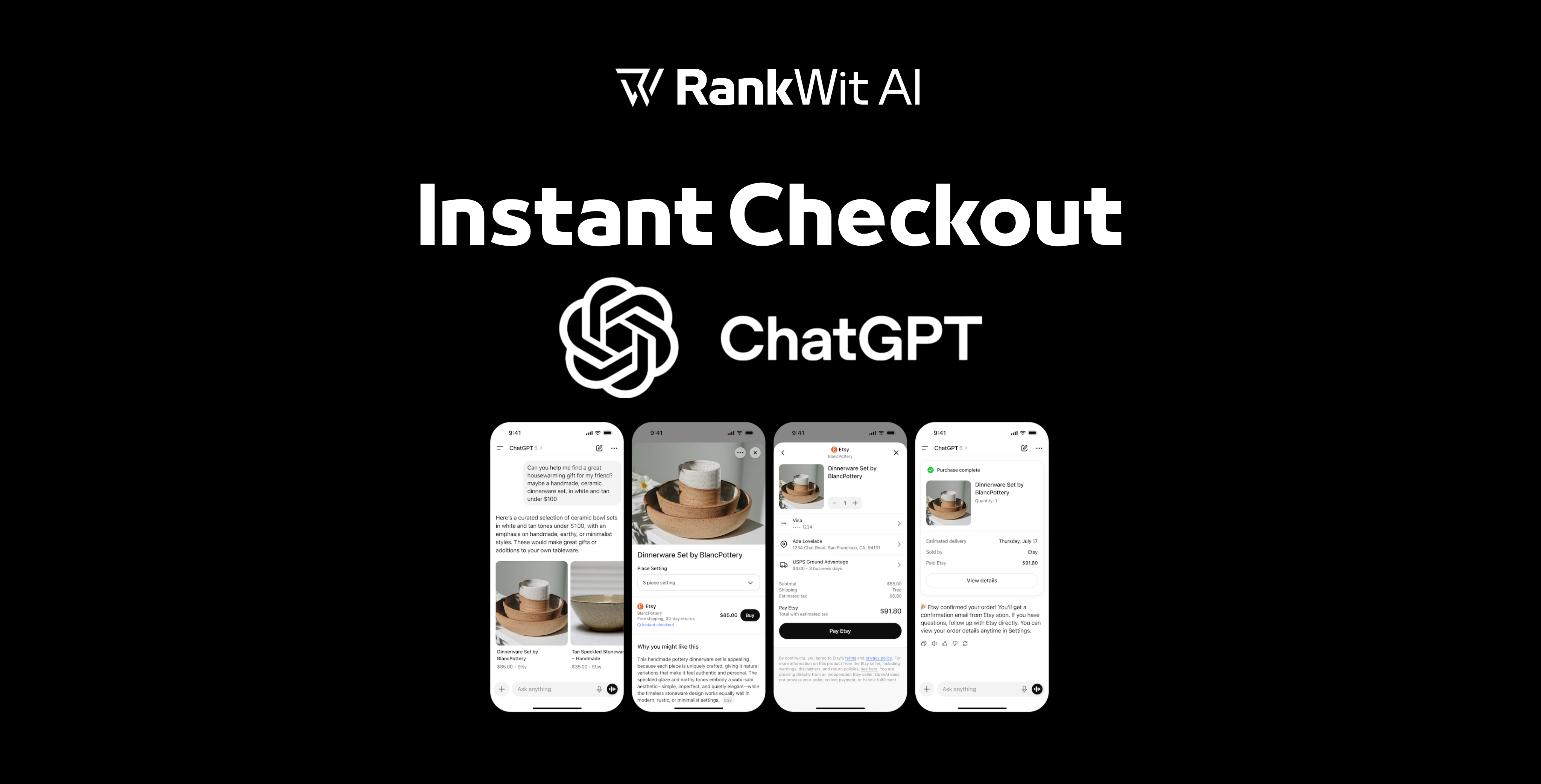
Is ChatGPT Instant Checkout available for all e-commerce platforms and regions?
Arrow

As of now, ChatGPT Instant Checkout is available only for merchants operating in the United States.
If your online store runs on Shopify or Etsy, you can already take advantage of this feature without any additional implementation, since these platforms are directly supported by OpenAI’s infrastructure.

For custom-built or enterprise e-commerce systems, a dedicated integration following the Agentic Commerce Protocol (ACP) is required.
Rankwit can assist your team in developing this integration—allowing you to access the U.S. market immediately and prepare for future international expansion as OpenAI rolls out the program globally.

Read More
ArrowArrow right blue
What is Agentic RAG?
Arrow

Agentic RAG represents a new paradigm in Retrieval-Augmented Generation (RAG).

While traditional RAG retrieves information to improve the accuracy of model outputs, Agentic RAG goes a step further by integrating autonomous agents that can plan, reason, and act across multi-step workflows.

This approach allows systems to:

  • Break down complex problems into smaller steps.
  • Decide dynamically which sources to retrieve and when.
  • Optimize workflows in real time for tasks such as legal reasoning, enterprise automation, or scientific research.

In other words, Agentic RAG doesn’t just provide better answers, but it strategically manages the retrieval process to support more accurate, efficient, and explainable decision-making.

Read More
ArrowArrow right blue
How is GEO different from SEO?
Arrow

GEO (Generative Engine Optimization) is not a rebrand of SEO—it’s a response to an entirely new environment. SEO optimizes for bots that crawl, index, and rank. GEO optimizes for large language models (LLMs) that read, learn, and generate human-like answers.

While SEO is built around keywords and backlinks, GEO is about semantic clarity, contextual authority, and conversational structuring. You're not trying to please an algorithm—you’re helping an AI understand and echo your ideas accurately in its responses. It's not just about being found—it's about being spoken for.

Read More
ArrowArrow right blue
How does WebMCP handle user privacy and prevent AI agents from performing unauthorized actions?
Arrow

Security is baked into the protocol's core. Unlike "headless" automation, WebMCP operates within the user’s current browser session:

  • Consent Gate: The browser acts as a gatekeeper, prompting the user to approve tool calls.
  • Scoped Access: AI agents only see the specific tools the developer has explicitly registered via the webmcp-tools suite.
  • Authentication: It leverages the site's existing login and security protocols, ensuring the AI never bypasses standard safety measures.

Read More
ArrowArrow right blue
How do large language models actually work, and why does that matter for GEO?
Arrow

Large Language Models (LLMs) like GPT are trained on vast amounts of text data to learn the patterns, structures, and relationships between words. At their core, they predict the next word in a sequence based on what came before—enabling them to generate coherent, human-like language.

This matters for GEO (Generative Engine Optimization) because it means your content must be:

  • Well-structured so LLMs can interpret and reuse it effectively.
  • Clear and specific, as models rely on patterns to make accurate predictions.
  • Contextually rich, because LLMs use surrounding context to generate responses.

By understanding how LLMs “think,” businesses can optimize content not just for humans or search engines—but for the AI models that are becoming the new discovery layer.

Bottom line: If your content helps the model predict the right answer, GEO helps users find you.

Read More
ArrowArrow right blue
What is tokenization, and why does it matter for GEO?
Arrow

Tokenization is the process by which AI models, like GPT, break down text into small units—called tokens—before processing. These tokens can be as small as a single character or as large as a word or phrase. For example, the word “marketing” might be one token, while “AI-powered tools” could be split into several.

Why does this matter for GEO (Generative Engine Optimization)?

Because how well your content is tokenized directly impacts how accurately it’s understood and retrieved by AI. Poorly structured or overly complex writing may confuse token boundaries, leading to missed context or incorrect responses.

Clear, concise language = better tokenization
Headings, lists, and structured data = easier to parse
Consistent terminology = improved AI recall

In short, optimizing for GEO means writing not just for readers or search engines, but also for how the AI tokenizes and interprets your content behind the scenes.

Read More
ArrowArrow right blue

📚 Learn, Apply, Win

Stay inspired with the latest stories, tips, and insights.
Explore articles designed to spark ideas, share knowledge, and keep you updated on what’s new.