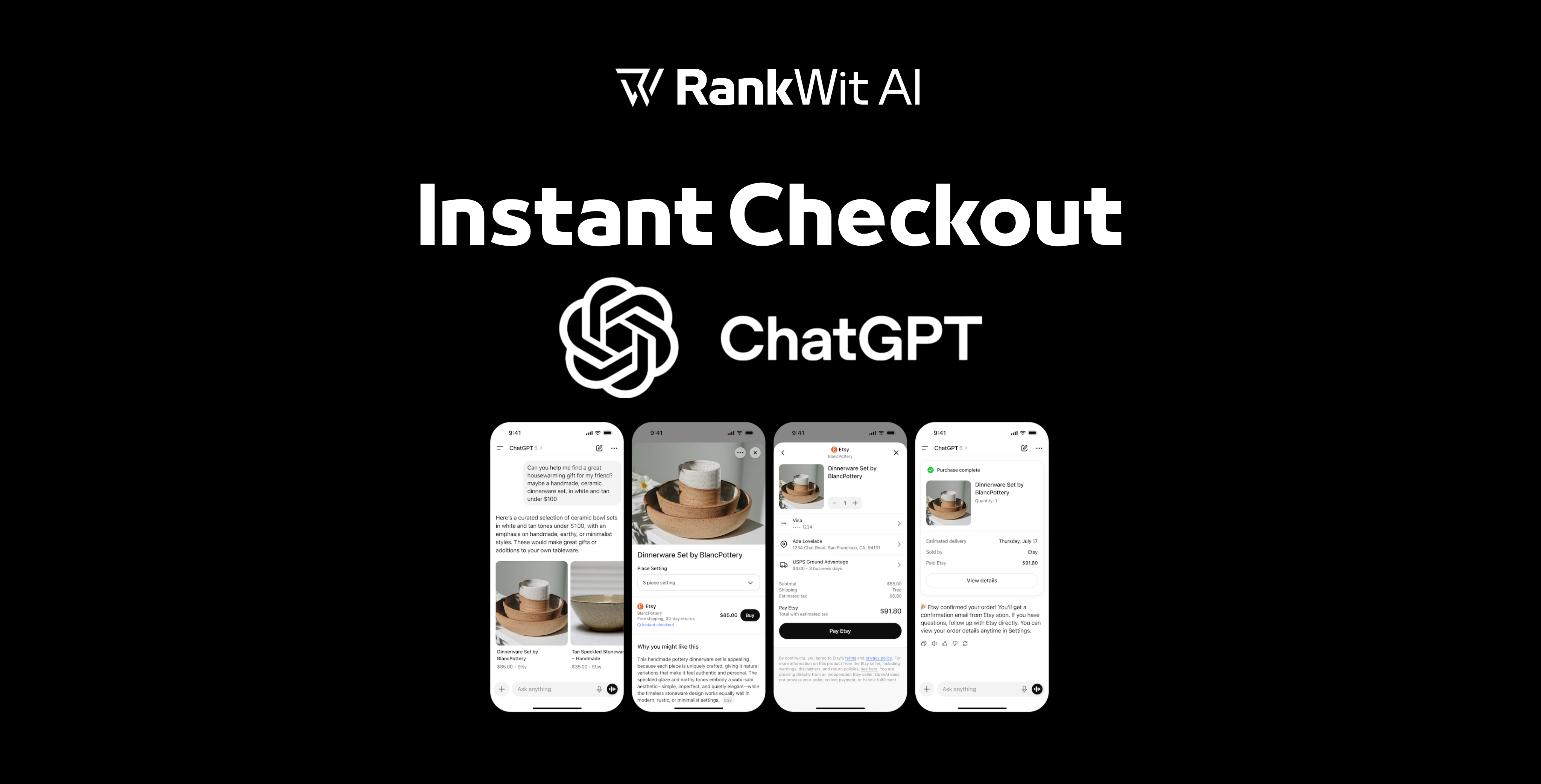
Is ChatGPT Instant Checkout available for all e-commerce platforms and regions?

As of now, ChatGPT Instant Checkout is available only for merchants operating in the United States.
If your online store runs on Shopify or Etsy, you can already take advantage of this feature without any additional implementation, since these platforms are directly supported by OpenAI’s infrastructure.

For custom-built or enterprise e-commerce systems, a dedicated integration following the Agentic Commerce Protocol (ACP) is required.
Rankwit can assist your team in developing this integration—allowing you to access the U.S. market immediately and prepare for future international expansion as OpenAI rolls out the program globally.

Last updated at  
February 24, 2026
Other FAQ
How long does setup take?
Arrow

Setup takes only a few minutes.
Just add your website, configure your prompts and RankWit begins analyzing your AI visibility immediately.

Read More
ArrowArrow right blue
What’s RAG (Retrieval-Augmented Generation), and why is it critical for GEO?
Arrow

RAG (Retrieval-Augmented Generation) is a cutting-edge AI technique that enhances traditional language models by integrating an external search or knowledge retrieval system. Instead of relying solely on pre-trained data, a RAG-enabled model can search a database or knowledge source in real time and use the results to generate more accurate, contextually relevant answers.

For GEO, this is a game changer.
GEO doesn't just respond with generic language—it retrieves fresh, relevant insights from your company’s knowledge base, documents, or external web content before generating its reply. This means:

  • More accurate and grounded answers
  • Up-to-date responses, even in dynamic environments
  • Context-aware replies tied to your data and terminology

By combining the strengths of generation and retrieval, RAG ensures GEO doesn't just sound smart—it is smart, aligned with your source of truth.

Read More
ArrowArrow right blue
How is GEO different from SEO?
Arrow

GEO (Generative Engine Optimization) is not a rebrand of SEO—it’s a response to an entirely new environment. SEO optimizes for bots that crawl, index, and rank. GEO optimizes for large language models (LLMs) that read, learn, and generate human-like answers.

While SEO is built around keywords and backlinks, GEO is about semantic clarity, contextual authority, and conversational structuring. You're not trying to please an algorithm—you’re helping an AI understand and echo your ideas accurately in its responses. It's not just about being found—it's about being spoken for.

Read More
ArrowArrow right blue
Why does GEO matter now?
Arrow

Generative Engine Optimization (GEO) is becoming increasingly critical as user behavior shifts toward AI-native search tools like ChatGPT, Gemini, and Perplexity.
According with Bain, recent data shows that over 40% of users now prefer AI-generated answers over traditional search engine results.
This trend reflects a major evolution in how people discover and consume information.

Unlike traditional SEO, which focuses on ranking in static search results, GEO ensures that your content is understandable, relevant, and authoritative enough to be cited or surfaced in LLM-generated responses.
This is especially important as AI platforms begin to integrate live web search capabilities, summaries, and citations directly into their answers.

The urgency is amplified by user traffic trends. According to Similarweb data (see chart below), ChatGPT visits are projected to surpass Google’s by December 2026 if current growth continues.
This suggests that visibility in LLMs may soon be as important—if not more—than traditional search rankings.

Projection based on traffic from the last 6 months (source: Similarweb US).

Read More
ArrowArrow right blue
What is AI Search Optimization and why is it important?
Arrow

AI Search Optimization refers to the practice of structuring, formatting, and presenting digital content to ensure it is surfaced by AI systems—particularly large language models (LLMs)—in response to user queries.Choosing a clear, unified name for this emerging field is crucial because it shapes professional standards, guides tool development, informs marketing strategies, and fosters a cohesive community of practice. Without a consistent term, the industry risks fragmentation and inefficiency, much like early digital marketing faced before "SEO" was widely adopted.

Read More
ArrowArrow right blue
What is Agentic RAG?
Arrow

Agentic RAG represents a new paradigm in Retrieval-Augmented Generation (RAG).

While traditional RAG retrieves information to improve the accuracy of model outputs, Agentic RAG goes a step further by integrating autonomous agents that can plan, reason, and act across multi-step workflows.

This approach allows systems to:

  • Break down complex problems into smaller steps.
  • Decide dynamically which sources to retrieve and when.
  • Optimize workflows in real time for tasks such as legal reasoning, enterprise automation, or scientific research.

In other words, Agentic RAG doesn’t just provide better answers, but it strategically manages the retrieval process to support more accurate, efficient, and explainable decision-making.

Read More
ArrowArrow right blue
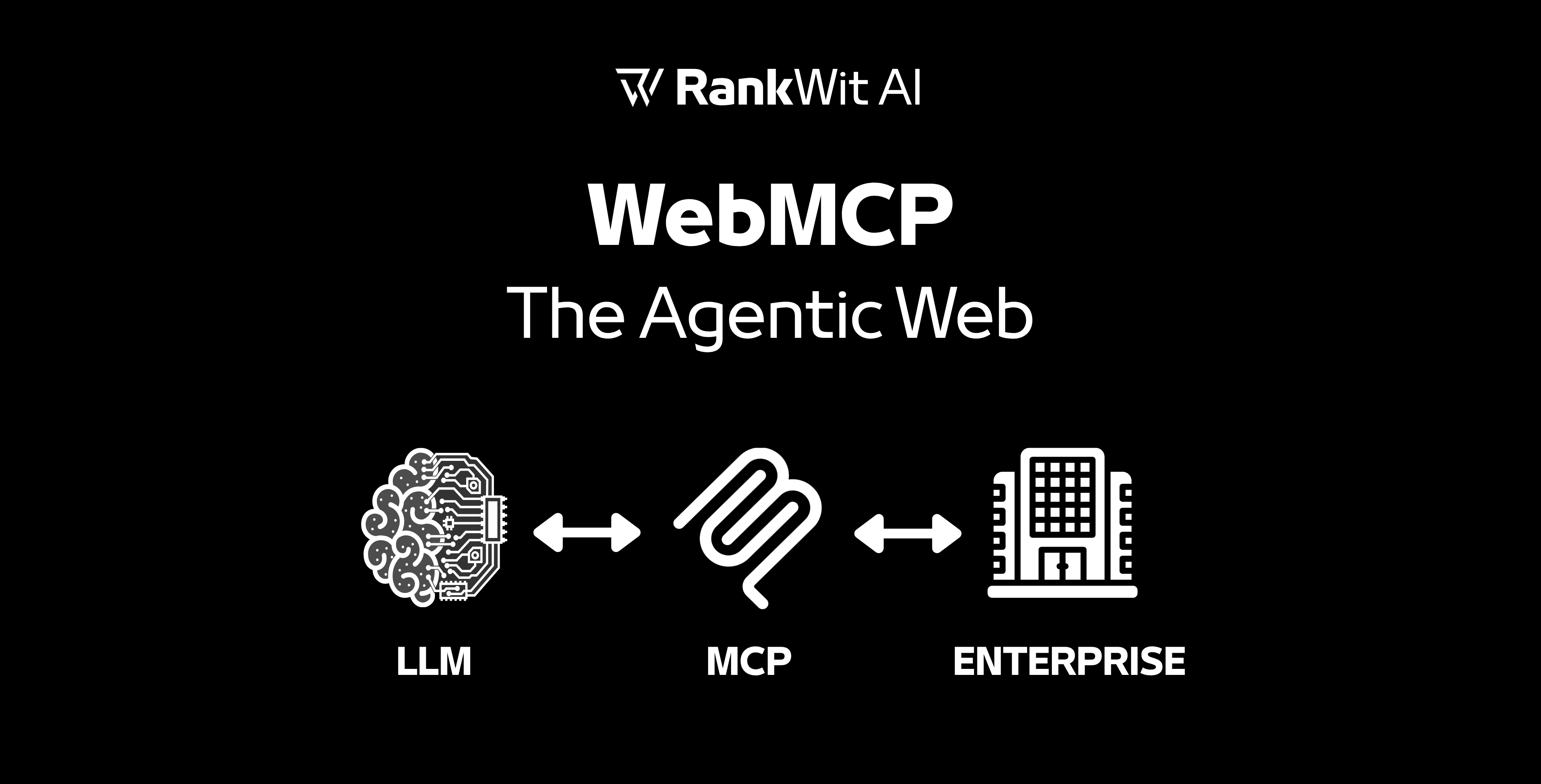
What does the term "Agentic Web" mean in the context of WebMCP technology?
Arrow

We are moving from a web of pixels to a web of actions.

  • Current Web: Users click, scroll, and read to finish a task.
  • Agentic Web (via WebMCP): A user gives a goal (e.g., "Find and book a flight under $400 for next Tuesday"), and the AI orchestrates the necessary steps across different sites using their exposed WebMCP tools.WebMCP provides the standardized language that allows these agents to navigate different platforms with the same ease a human would, but with the speed of an API.

Read More
ArrowArrow right blue
Does RankWit support multiple countries?
Arrow

Yes! RankWit includes unlimited country tracking across all plans at no additional cost.
You can monitor AI visibility for any market worldwide.

Read More
ArrowArrow right blue
How are RankWit credits calculated?
Arrow

Credits determine how much AI tracking you perform.
A single credit = 1 prompt × 1 AI model.

For example:

  • 10 prompts
  • × 3 AI models (ChatGPT, Google AI Overview, Perplexity)
    = 30 credits

This transparent system ensures you only pay for the tracking you use.

Read More
ArrowArrow right blue
What is ChatGPT Shopping Research and how does it work?
Arrow

Shopping Research is a feature in ChatGPT that acts as a personalized shopping assistant.
Simply describe what you’re looking for, such as “a lightweight laptop for travel”, and ChatGPT gathers product details, reviews, specs, prices, and comparisons from the web.

You can refine the results by marking products as “Not interested” or “More like this”, helping ChatGPT understand your preferences.

At the end, you receive a custom buyer’s guide that explains the pros, cons, and trade-offs of each option, making your purchase process easier and more informed.

Read More
ArrowArrow right blue

📚 Learn, Apply, Win

Stay inspired with the latest stories, tips, and insights.
Explore articles designed to spark ideas, share knowledge, and keep you updated on what’s new.