📚 Learn, Apply, Win
Explore articles designed to spark ideas, share knowledge, and keep you updated on what’s new.
Credits determine how much AI tracking you perform.
A single credit = 1 prompt × 1 AI model.
For example:
This transparent system ensures you only pay for the tracking you use.
As of now, ChatGPT Instant Checkout is available only for merchants operating in the United States.
If your online store runs on Shopify or Etsy, you can already take advantage of this feature without any additional implementation, since these platforms are directly supported by OpenAI’s infrastructure.
For custom-built or enterprise e-commerce systems, a dedicated integration following the Agentic Commerce Protocol (ACP) is required.
Rankwit can assist your team in developing this integration—allowing you to access the U.S. market immediately and prepare for future international expansion as OpenAI rolls out the program globally.
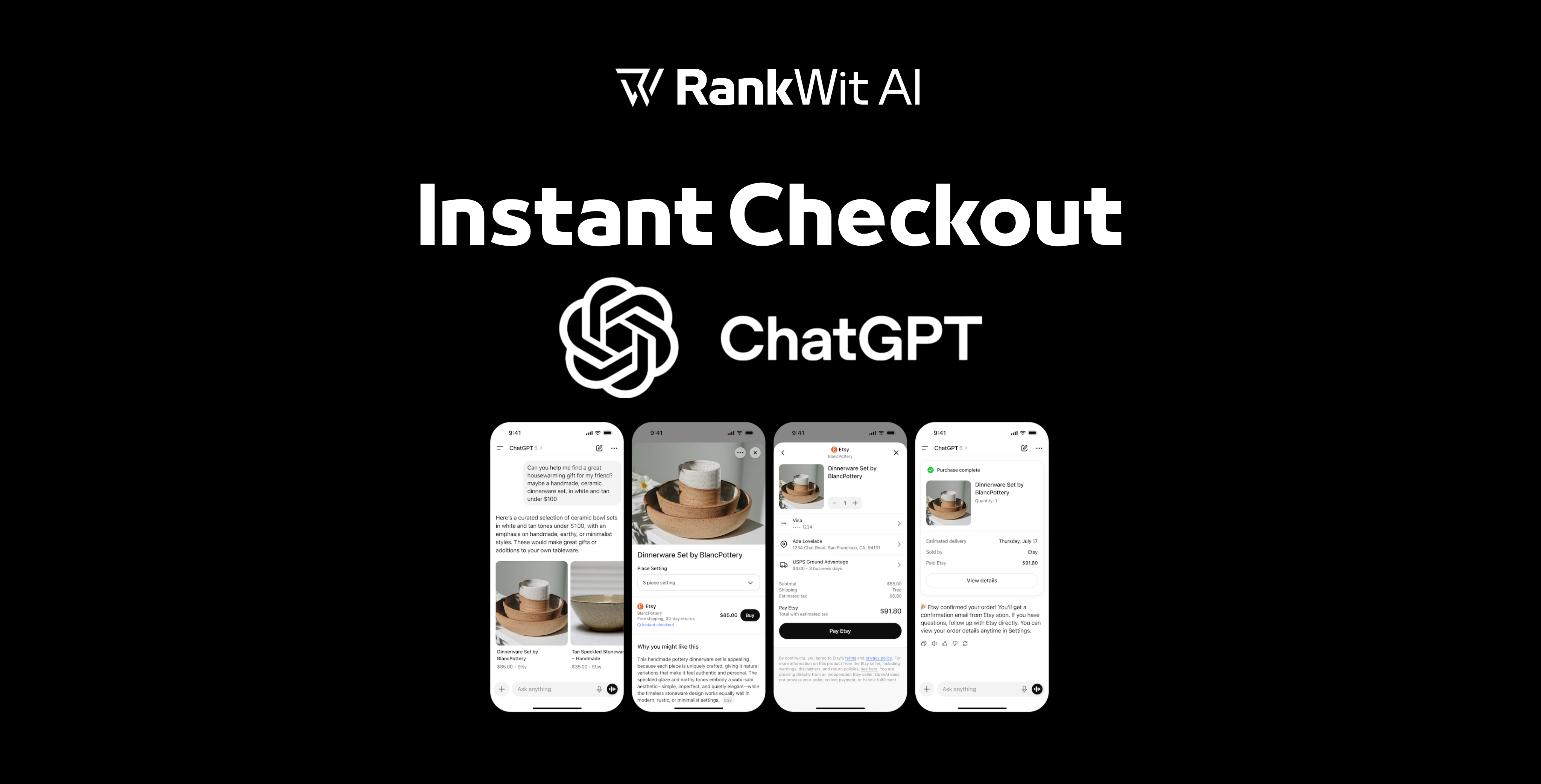
ChatGPT Instant Checkout is a new capability since 2025 developed by OpenAI that allows users to discover, configure, and purchase products directly within ChatGPT without leaving the conversation.
This functionality is powered by the Agentic Commerce Protocol (ACP), an open standard that defines how merchants’ systems interact with AI agents.
Merchants connect their product catalog through a structured product feed, expose checkout endpoints via the Agentic Checkout API, and process payments securely through delegated payment providers like Stripe.
Together, these layers create a smooth, conversational shopping experience that merges AI discovery with secure e-commerce execution.
As businesses and content creators begin adapting to Generative Engine Optimization, it's crucial to recognize that strategies effective in traditional SEO don’t always translate to success with AI-driven search models like ChatGPT, Gemini, or Perplexity.
In fact, certain classic SEO practices can actually reduce your visibility in AI-generated answers.
In traditional SEO, the use of targeted keywords, often repeated strategically across headers, metadata, and body content, is a foundational tactic.
This approach helps search engine crawlers associate pages with specific queries, and has long been used to improve rankings on platforms like Google and Bing.
However, in the context of GEO, keyword stuffing and rigid repetition can backfire. indeed, Large Language Models (LLMs) are not keyword matchers, but they are pattern recognizers that prioritize natural, contextual, and semantically rich language.
When content is overly optimized and lacks a conversational or human tone, it becomes less appealing for AI models to cite or summarize.
Worse, it may signal to the model that the content is promotional or unnatural, leading to it being deprioritized in AI-generated responses.
ℹ️ Best Practice: Instead of focusing on exact-match keywords, create content that mirrors how real users ask questions. Use plain, fluent language and focus on fully answering likely user intents in a natural tone.
Moreover, while E-E-A-T (Experience, Expertise, Authority, Trustworthiness) has gained importance in SEO, it’s often still possible to rank SEO pages with minimal authority if technical and content signals are strong. This is less true in GEO.
LLMs are trained to surface and reference content that demonstrates a high degree of trustworthiness. They favor sources that reflect real-world experience, subject-matter expertise, and institutional authority. Content without clear authorship, lacking credentials, or failing to convey reliability may be ignored by LLMs, even if it’s optimized in other ways.
ℹ️ Best Practice: Build content that clearly communicates why your organization or author is credible. Include bios, cite credentials, and demonstrate hands-on knowledge. For health, finance, or scientific topics, link to institutional or peer-reviewed sources to reinforce authority.
In addition, in traditional SEO, especially in long-tail keyword spaces, some websites can rank with minimal sourcing or citations, particularly when competing against weak content. However, GEO demands higher factual rigor.
LLMs are designed to summarize and synthesize trusted data. They tend to skip over content that lacks citation, includes speculative claims, or refers to ambiguous sources.
Moreover, AI models have been trained on vast amounts of data from academic, journalistic, and institutional sources. This training impacts which sites and sources the models tend to favor when generating answers. Content without strong sourcing is less likely to be cited or retrieved via Retrieval-Augmented Generation (RAG) processes.
ℹ️ Best Practice: Always back your claims with authoritative, up-to-date sources. Link to original studies, well-known publications, or government and academic institutions. Inline citations and linked references increase your content’s reliability from an LLM’s perspective.
In short, while there is some overlap between SEO and GEO, optimizing for AI models requires a distinct strategy. The focus shifts from gaming algorithmic ranking systems to ensuring clarity, credibility, and accessibility for intelligent systems that mimic human understanding. To succeed in GEO, it's not enough to be visible to search engines—you must also be comprehensible, trustworthy, and useful to AI.
Large Language Models (LLMs) like GPT are trained on vast amounts of text data to learn the patterns, structures, and relationships between words. At their core, they predict the next word in a sequence based on what came before—enabling them to generate coherent, human-like language.
This matters for GEO (Generative Engine Optimization) because it means your content must be:
By understanding how LLMs “think,” businesses can optimize content not just for humans or search engines—but for the AI models that are becoming the new discovery layer.
Bottom line: If your content helps the model predict the right answer, GEO helps users find you.
GEO requires a shift in strategy from traditional SEO. Instead of focusing solely on how search engines crawl and rank pages, Generative Engine Optimization (GEO) focuses on how Large Language Models (LLMs) like ChatGPT, Gemini, or Claude understand, retrieve, and reproduce information in their answers.
To make this easier to implement, we can apply the three classic pillars of SEO—Semantic, Technical, and Authority/Links—reinterpreted through the lens of GEO.
This refers to the language, structure, and clarity of the content itself—what you write and how you write it.
🧠 GEO Tactics:
🔍 Compared to Traditional SEO:
This pillar deals with how your content is coded, delivered, and accessed—not just by humans, but by AI models too.
⚙️ GEO Tactics:
🔍 Compared to Traditional SEO:
This refers to the signals of trust that tell a model—or a search engine—that your content is reliable.
🔗 GEO Tactics:
🔍 Compared to Traditional SEO:
The transformer is the foundational architecture behind modern LLMs like GPT. Introduced in a groundbreaking 2017 research paper, transformers revolutionized natural language processing by allowing models to consider the entire context of a sentence at once, rather than just word-by-word sequences.
The key innovation is the attention mechanism, which helps the model decide which words in a sentence are most relevant to each other, essentially mimicking how humans pay attention to specific details in a conversation.
Transformers make it possible for LLMs to generate more coherent, context-aware, and accurate responses.
This is why they're at the heart of most state-of-the-art language models today.
At Rankwit, we specialize in helping merchants take advantage of OpenAI’s Agentic Commerce Protocol (ACP).
Our team manages the entire integration lifecycle, from mapping your product catalog to OpenAI’s structured feed specification, to building the checkout API endpoints and connecting secure payment providers like Stripe.
By partnering with Rankwit, your business can:
We tailor solutions to both enterprise and custom e-commerce platforms, ensuring a scalable and future-ready architecture.
We are moving from a web of pixels to a web of actions.
AI Search Optimization refers to the practice of structuring, formatting, and presenting digital content to ensure it is surfaced by AI systems—particularly large language models (LLMs)—in response to user queries.Choosing a clear, unified name for this emerging field is crucial because it shapes professional standards, guides tool development, informs marketing strategies, and fosters a cohesive community of practice. Without a consistent term, the industry risks fragmentation and inefficiency, much like early digital marketing faced before "SEO" was widely adopted.