What role does WebMCP play in Retrieval-Augmented Generation (RAG) and real-time search?

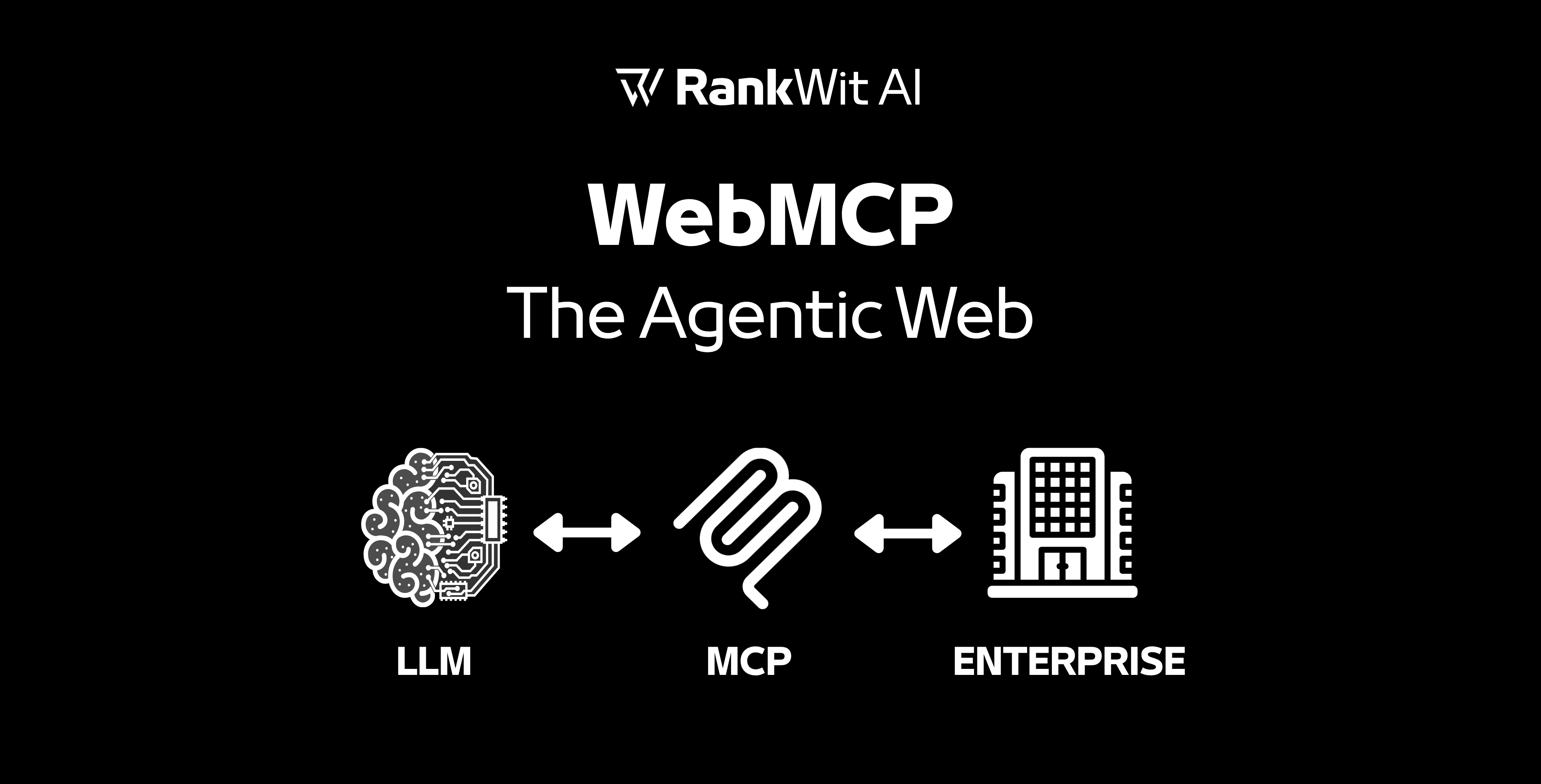
Traditional LLMs are limited by their training data "cutoff" dates. WebMCP bridges this gap by enabling Dynamic Context Injection:

  • The model identifies it needs live data (e.g., "What is the current inventory of Product X?").
  • It uses the WebMCP bidirectional channel to query the server.
  • The server returns structured data, which the AI then uses to generate an accurate, up-to-the-minute response.

Last updated at  
February 20, 2026
Other FAQ
What is AI Search Optimization and why is it important?
Arrow

AI Search Optimization refers to the practice of structuring, formatting, and presenting digital content to ensure it is surfaced by AI systems—particularly large language models (LLMs)—in response to user queries.Choosing a clear, unified name for this emerging field is crucial because it shapes professional standards, guides tool development, informs marketing strategies, and fosters a cohesive community of practice. Without a consistent term, the industry risks fragmentation and inefficiency, much like early digital marketing faced before "SEO" was widely adopted.

Read More
ArrowArrow right blue
What does the term "Agentic Web" mean in the context of WebMCP technology?
Arrow

We are moving from a web of pixels to a web of actions.

  • Current Web: Users click, scroll, and read to finish a task.
  • Agentic Web (via WebMCP): A user gives a goal (e.g., "Find and book a flight under $400 for next Tuesday"), and the AI orchestrates the necessary steps across different sites using their exposed WebMCP tools.WebMCP provides the standardized language that allows these agents to navigate different platforms with the same ease a human would, but with the speed of an API.

Read More
ArrowArrow right blue
Does RankWit support multiple countries?
Arrow

Yes! RankWit includes unlimited country tracking across all plans at no additional cost.
You can monitor AI visibility for any market worldwide.

Read More
ArrowArrow right blue
Will GEO replace SEO in how businesses get discovered online
Arrow

GEO is not a replacement for SEO—it’s an evolution of how users interact with information online.

While SEO (Search Engine Optimization) focuses on ranking content in traditional search engines like Google, GEO (Generative Engine Optimization) focuses on making content discoverable and useful within AI-powered search and assistant experiences.

Here’s how they differ and work together:

  • SEO drives visibility on web search engines. It optimizes for keywords, backlinks, and structured content to help pages rank high.
  • GEO optimizes for AI discovery. It ensures your content is easily understood, retrieved, and accurately cited by AI tools like ChatGPT, Perplexity, or Claude.

As AI assistants increasingly become the first touchpoint for information retrieval, GEO is becoming essential. But SEO is still critical for attracting traffic from search engines and building long-term domain authority.

In short: GEO enhances your content’s AI-readiness, while SEO ensures it’s search-engine-ready. The future is not SEO or GEO—it’s SEO and GEO, working in tandem.

Read More
ArrowArrow right blue
What is ChatGPT Shopping Research and how does it work?
Arrow

Shopping Research is a feature in ChatGPT that acts as a personalized shopping assistant.
Simply describe what you’re looking for, such as “a lightweight laptop for travel”, and ChatGPT gathers product details, reviews, specs, prices, and comparisons from the web.

You can refine the results by marking products as “Not interested” or “More like this”, helping ChatGPT understand your preferences.

At the end, you receive a custom buyer’s guide that explains the pros, cons, and trade-offs of each option, making your purchase process easier and more informed.

Read More
ArrowArrow right blue
How does WebMCP handle user privacy and prevent AI agents from performing unauthorized actions?
Arrow

Security is baked into the protocol's core. Unlike "headless" automation, WebMCP operates within the user’s current browser session:

  • Consent Gate: The browser acts as a gatekeeper, prompting the user to approve tool calls.
  • Scoped Access: AI agents only see the specific tools the developer has explicitly registered via the webmcp-tools suite.
  • Authentication: It leverages the site's existing login and security protocols, ensuring the AI never bypasses standard safety measures.

Read More
ArrowArrow right blue
What is tokenization, and why does it matter for GEO?
Arrow

Tokenization is the process by which AI models, like GPT, break down text into small units—called tokens—before processing. These tokens can be as small as a single character or as large as a word or phrase. For example, the word “marketing” might be one token, while “AI-powered tools” could be split into several.

Why does this matter for GEO (Generative Engine Optimization)?

Because how well your content is tokenized directly impacts how accurately it’s understood and retrieved by AI. Poorly structured or overly complex writing may confuse token boundaries, leading to missed context or incorrect responses.

Clear, concise language = better tokenization
Headings, lists, and structured data = easier to parse
Consistent terminology = improved AI recall

In short, optimizing for GEO means writing not just for readers or search engines, but also for how the AI tokenizes and interprets your content behind the scenes.

Read More
ArrowArrow right blue
Is ChatGPT Instant Checkout available for all e-commerce platforms and regions?
Arrow

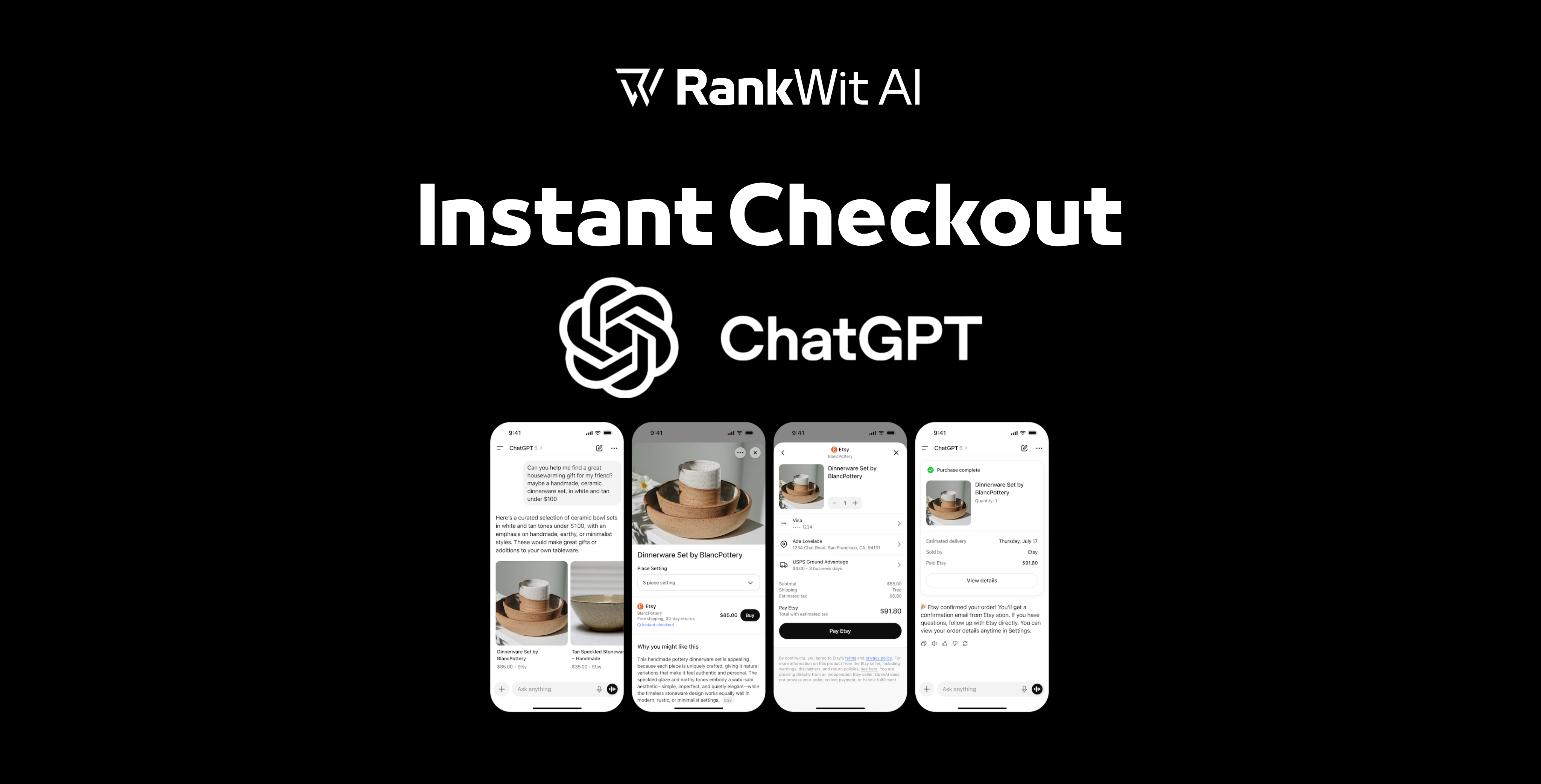
As of now, ChatGPT Instant Checkout is available only for merchants operating in the United States.
If your online store runs on Shopify or Etsy, you can already take advantage of this feature without any additional implementation, since these platforms are directly supported by OpenAI’s infrastructure.

For custom-built or enterprise e-commerce systems, a dedicated integration following the Agentic Commerce Protocol (ACP) is required.
Rankwit can assist your team in developing this integration—allowing you to access the U.S. market immediately and prepare for future international expansion as OpenAI rolls out the program globally.

Read More
ArrowArrow right blue
What are common mistakes in Generative Engine Optimization (GEO)?
Arrow

As businesses and content creators begin adapting to Generative Engine Optimization, it's crucial to recognize that strategies effective in traditional SEO don’t always translate to success with AI-driven search models like ChatGPT, Gemini, or Perplexity.

In fact, certain classic SEO practices can actually reduce your visibility in AI-generated answers.

In traditional SEO, the use of targeted keywords, often repeated strategically across headers, metadata, and body content, is a foundational tactic.
This approach helps search engine crawlers associate pages with specific queries, and has long been used to improve rankings on platforms like Google and Bing.

However, in the context of GEO, keyword stuffing and rigid repetition can backfire. indeed, Large Language Models (LLMs) are not keyword matchers, but they are pattern recognizers that prioritize natural, contextual, and semantically rich language.
When content is overly optimized and lacks a conversational or human tone, it becomes less appealing for AI models to cite or summarize.
Worse, it may signal to the model that the content is promotional or unnatural, leading to it being deprioritized in AI-generated responses.

ℹ️ Best Practice: Instead of focusing on exact-match keywords, create content that mirrors how real users ask questions. Use plain, fluent language and focus on fully answering likely user intents in a natural tone.

Moreover, while E-E-A-T (Experience, Expertise, Authority, Trustworthiness) has gained importance in SEO, it’s often still possible to rank SEO pages with minimal authority if technical and content signals are strong. This is less true in GEO.

LLMs are trained to surface and reference content that demonstrates a high degree of trustworthiness. They favor sources that reflect real-world experience, subject-matter expertise, and institutional authority. Content without clear authorship, lacking credentials, or failing to convey reliability may be ignored by LLMs, even if it’s optimized in other ways.

ℹ️ Best Practice: Build content that clearly communicates why your organization or author is credible. Include bios, cite credentials, and demonstrate hands-on knowledge. For health, finance, or scientific topics, link to institutional or peer-reviewed sources to reinforce authority.


In addition, in traditional SEO, especially in long-tail keyword spaces, some websites can rank with minimal sourcing or citations, particularly when competing against weak content. However, GEO demands higher factual rigor.
LLMs are designed to summarize and synthesize trusted data. They tend to skip over content that lacks citation, includes speculative claims, or refers to ambiguous sources.

Moreover, AI models have been trained on vast amounts of data from academic, journalistic, and institutional sources. This training impacts which sites and sources the models tend to favor when generating answers. Content without strong sourcing is less likely to be cited or retrieved via Retrieval-Augmented Generation (RAG) processes.

ℹ️ Best Practice: Always back your claims with authoritative, up-to-date sources. Link to original studies, well-known publications, or government and academic institutions. Inline citations and linked references increase your content’s reliability from an LLM’s perspective.

In short, while there is some overlap between SEO and GEO, optimizing for AI models requires a distinct strategy. The focus shifts from gaming algorithmic ranking systems to ensuring clarity, credibility, and accessibility for intelligent systems that mimic human understanding. To succeed in GEO, it's not enough to be visible to search engines—you must also be comprehensible, trustworthy, and useful to AI.

Read More
ArrowArrow right blue
What export formats are available?
Arrow

RankWit makes reporting simple.
You can export all tracking data in multiple formats, including:

  • PDF
  • CSV
  • Word documents
  • Custom reporting templates

This makes sharing insights with clients or leadership fast and flexible.

Read More
ArrowArrow right blue

📚 Learn, Apply, Win

Stay inspired with the latest stories, tips, and insights.
Explore articles designed to spark ideas, share knowledge, and keep you updated on what’s new.