What’s the difference between GEO and AEO?

Generative Engine Optimization (GEO) and Answer Engine Optimization (AEO) are closely related strategies, but they serve different purposes in how content is discovered and used by AI technologies.

  • AEO is focused on helping your content become the direct answer to user queries in AI-powered answer engines like Google's SGE (Search Generative Experience), Bing, or voice assistants. It emphasizes clear formatting, Q&A structure, and schema markup so that AI systems can easily extract and present your content in snippets or spoken responses.
  • GEO, on the other hand, is a broader approach designed to ensure your content is used, synthesized, or cited by generative AI models like ChatGPT, Gemini, Claude, and Perplexity. It involves creating high-quality, authoritative content that large language models (LLMs) recognize as trustworthy and relevant. It may also include using metadata tools (like llms.txt) to guide how AI systems interpret and prioritize your content.
In short:
AEO helps you be the answer in AI search results. GEO helps you be the source that generative AI platforms trust and cite.

Together, these strategies are essential for maximizing visibility in an AI-first search landscape.

Last updated at  
June 30, 2025
Other FAQ
How does WebMCP differ from traditional web scraping when AI agents interact with websites?
Arrow

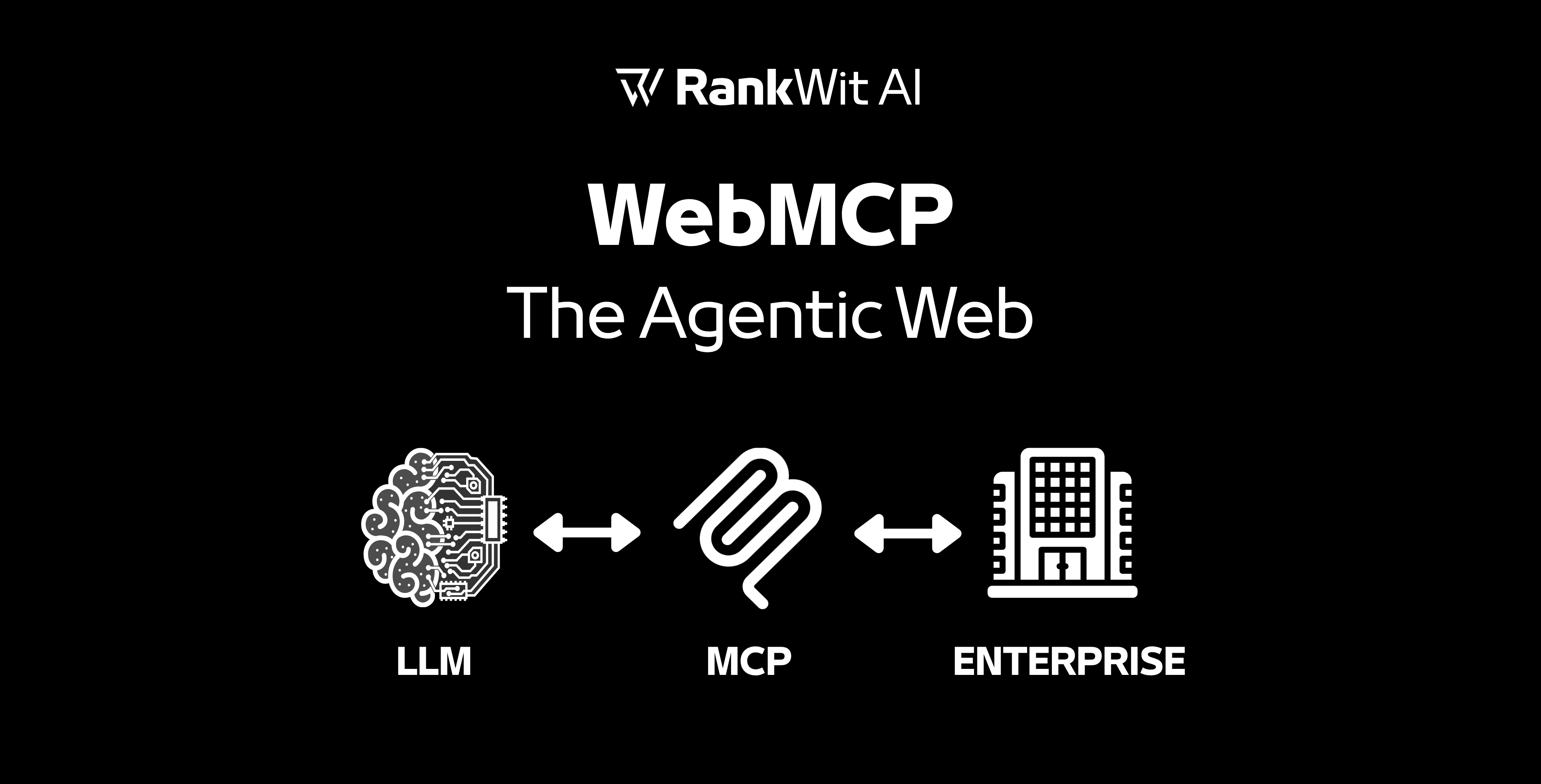
While traditional scraping is fragile and prone to breaking when a website's design changes, WebMCP provides a reliable "handshake" between the site and the AI.

  • Direct Access: Agents call specific functions (tools) instead of searching for buttons in code.
  • Resilience: Site layout changes don't break the integration as long as the underlying WebMCP schema remains the same.
  • Efficiency: It significantly reduces the tokens and compute power needed for an AI to "understand" a page

Read More
ArrowArrow right blue
How do large language models actually work, and why does that matter for GEO?
Arrow

Large Language Models (LLMs) like GPT are trained on vast amounts of text data to learn the patterns, structures, and relationships between words. At their core, they predict the next word in a sequence based on what came before—enabling them to generate coherent, human-like language.

This matters for GEO (Generative Engine Optimization) because it means your content must be:

  • Well-structured so LLMs can interpret and reuse it effectively.
  • Clear and specific, as models rely on patterns to make accurate predictions.
  • Contextually rich, because LLMs use surrounding context to generate responses.

By understanding how LLMs “think,” businesses can optimize content not just for humans or search engines—but for the AI models that are becoming the new discovery layer.

Bottom line: If your content helps the model predict the right answer, GEO helps users find you.

Read More
ArrowArrow right blue
What is ChatGPT Instant Checkout and how does it work for e-commerce merchants?
Arrow

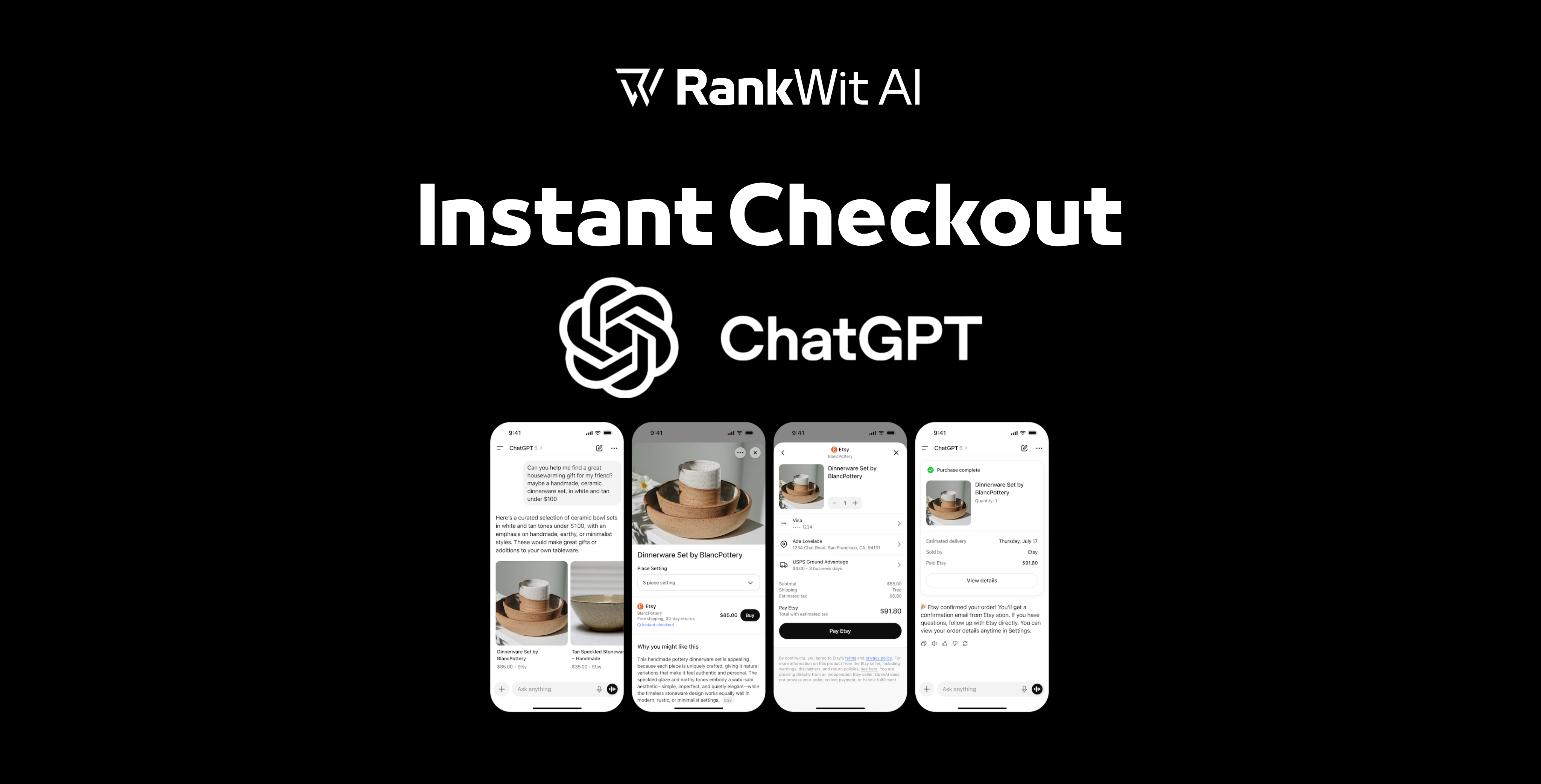
ChatGPT Instant Checkout is a new capability since 2025 developed by OpenAI that allows users to discover, configure, and purchase products directly within ChatGPT without leaving the conversation.
This functionality is powered by the Agentic Commerce Protocol (ACP), an open standard that defines how merchants’ systems interact with AI agents.

Merchants connect their product catalog through a structured product feed, expose checkout endpoints via the Agentic Checkout API, and process payments securely through delegated payment providers like Stripe.
Together, these layers create a smooth, conversational shopping experience that merges AI discovery with secure e-commerce execution.

Read More
ArrowArrow right blue
What kind of optimization recommendations does RankWit provide?
Arrow

RankWit analyzes your existing content and gives actionable, data-backed recommendations for improving your AI visibility. Suggestions include:

  • Rewriting sentences to be more concise and AI-parsable
  • Restructuring content into formats AI engines prefer (e.g., lists, FAQs, summaries)
  • Highlighting authority signals, such as including stats, sources, or clear claims
    These optimizations are designed to increase the chances that AI platforms surface your content over competitors’.

Read More
ArrowArrow right blue
What export formats are available?
Arrow

RankWit makes reporting simple.
You can export all tracking data in multiple formats, including:

  • PDF
  • CSV
  • Word documents
  • Custom reporting templates

This makes sharing insights with clients or leadership fast and flexible.

Read More
ArrowArrow right blue
How can I optimize for GEO?
Arrow

GEO requires a shift in strategy from traditional SEO. Instead of focusing solely on how search engines crawl and rank pages, Generative Engine Optimization (GEO) focuses on how Large Language Models (LLMs) like ChatGPT, Gemini, or Claude understand, retrieve, and reproduce information in their answers.

To make this easier to implement, we can apply the three classic pillars of SEO—Semantic, Technical, and Authority/Links—reinterpreted through the lens of GEO.

1. Semantic Optimization (Text & Content Layer)

This refers to the language, structure, and clarity of the content itself—what you write and how you write it.

🧠 GEO Tactics:

  • Conversational Clarity: Use natural, question-answer formats that match how users interact with LLMs.
  • RAG-Friendly Layouts: Structure content so that models using Retrieval-Augmented Generation can easily locate and summarize it.
  • Authoritative Tone: Avoid vague or overly promotional language—LLMs favor clear, factual statements.
  • Structured Headers: Use H2s and H3s to define sections. LLMs rely heavily on this hierarchy for context segmentation.

🔍 Compared to Traditional SEO:

  • Similarity: Both value clarity, keyword-rich subheadings, and topic coverage.
  • Difference: GEO prioritizes contextual relevance and direct answers over keyword stuffing or search volume targeting.

2. Technical Optimization

This pillar deals with how your content is coded, delivered, and accessed—not just by humans, but by AI models too.

⚙️ GEO Tactics:

  • Structured Data (Schema Markup): Clearly define entities and relationships so LLMs can understand context.
  • Crawlability & Load Time: Still important, especially when LLMs like ChatGPT or Perplexity use live browsing.
  • Model-Friendly Formats: Prefer clean HTML, markdown, or plaintext—avoid heavy JavaScript that can block content visibility.
  • Zero-Click Readiness: Craft summaries and paragraphs that can stand alone, knowing the user may never visit your site.

🔍 Compared to Traditional SEO:

  • Similarity: Both benefit from clean code, fast performance, and schema markup.
  • Difference: GEO focuses on how readable and usable your content is for AI, not just browsers.

3. Authority & Link Strategy

This refers to the signals of trust that tell a model—or a search engine—that your content is reliable.

🔗 GEO Tactics:

  • Credible Sources: Reference reliable, third-party data (.gov, .edu, research papers). LLMs often echo content from trusted domains.
  • Internal Linking: Connect related content pieces to help LLMs understand topic depth and relationships.
  • Brand Mentions: Even unlinked brand citations across the web may boost your perceived credibility in LLMs’ training and inference models.

🔍 Compared to Traditional SEO:

  • Similarity: Both reward strong domain reputation and high-quality references.
  • Difference: GEO may rely more on accuracy and perceived authority across training data than on backlink volume or anchor text.

Read More
ArrowArrow right blue
How long does setup take?
Arrow

Setup takes only a few minutes.
Just add your website, configure your prompts and RankWit begins analyzing your AI visibility immediately.

Read More
ArrowArrow right blue
What role does WebMCP play in Retrieval-Augmented Generation (RAG) and real-time search?
Arrow

Traditional LLMs are limited by their training data "cutoff" dates. WebMCP bridges this gap by enabling Dynamic Context Injection:

  • The model identifies it needs live data (e.g., "What is the current inventory of Product X?").
  • It uses the WebMCP bidirectional channel to query the server.
  • The server returns structured data, which the AI then uses to generate an accurate, up-to-the-minute response.

Read More
ArrowArrow right blue
How does RankWit track AI visibility?
Arrow

RankWit gives you a complete picture of how your brand appears across major AI platforms.
We run structured prompts through leading AI systems (including ChatGPT, Google AI Overview, and Perplexity) and then evaluate the responses for:

  • Brand mentions
  • Sentiment
  • Ranking or positioning
  • Competitor visibility
  • Opportunities and risks

This analysis helps you understand exactly how AI systems perceive and present your brand.

Read More
ArrowArrow right blue
How can Rankwit help my business integrate with ChatGPT’s Agentic Commerce Protocol?
Arrow

At Rankwit, we specialize in helping merchants take advantage of OpenAI’s Agentic Commerce Protocol (ACP).
Our team manages the entire integration lifecycle, from mapping your product catalog to OpenAI’s structured feed specification, to building the checkout API endpoints and connecting secure payment providers like Stripe.

By partnering with Rankwit, your business can:

  • Launch AI-powered conversational shopping experiences inside ChatGPT.
  • Achieve full compliance with OpenAI and PCI DSS standards.
  • Gain an unfair competitive advantage by adopting this technology before it becomes mainstream.

We tailor solutions to both enterprise and custom e-commerce platforms, ensuring a scalable and future-ready architecture.

Read More
ArrowArrow right blue

📚 Learn, Apply, Win

Stay inspired with the latest stories, tips, and insights.
Explore articles designed to spark ideas, share knowledge, and keep you updated on what’s new.