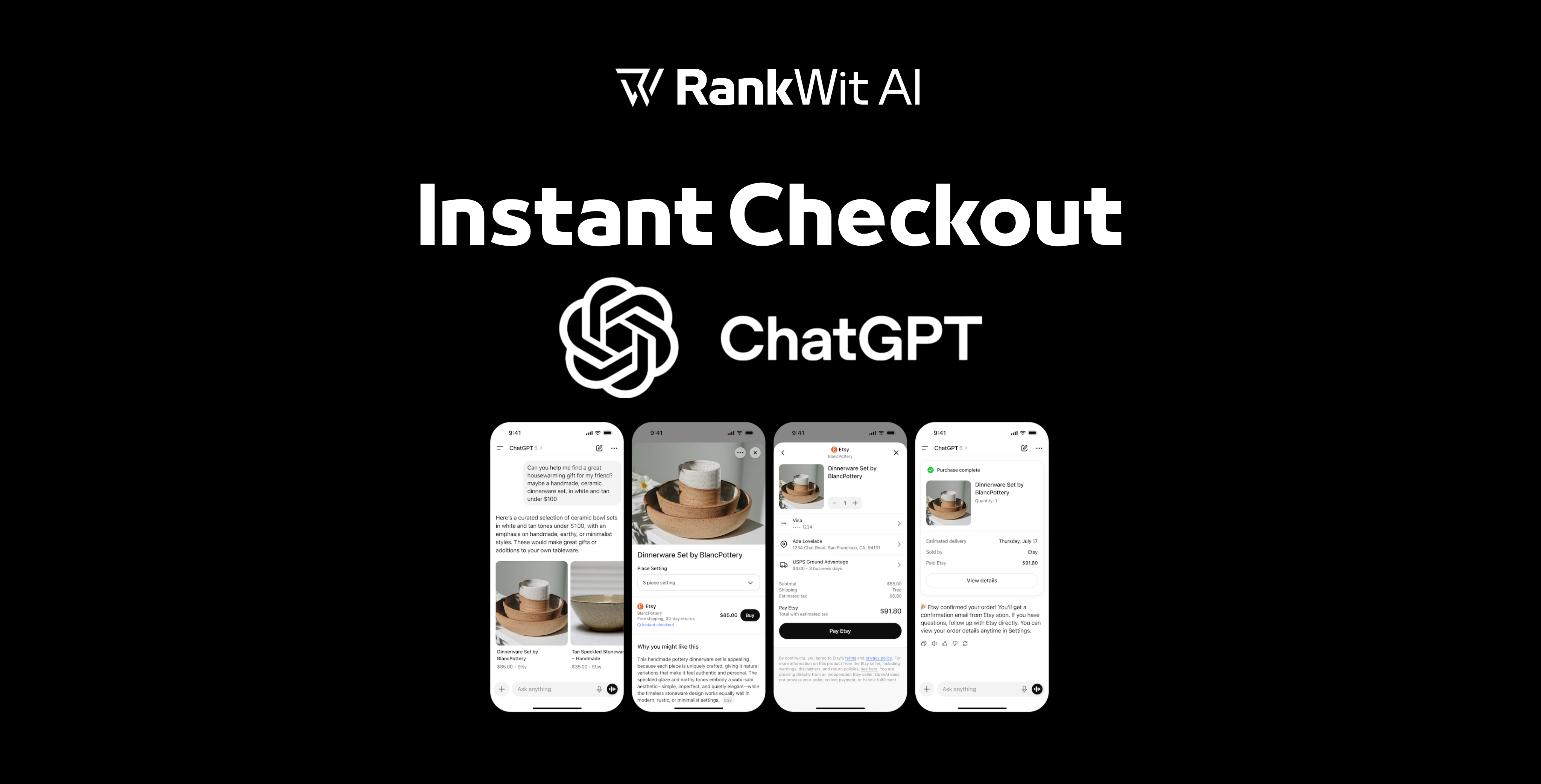
What is ChatGPT Instant Checkout and how does it work for e-commerce merchants?
ChatGPT Instant Checkout is a new capability since 2025 developed by OpenAI that allows users to discover, configure, and purchase products directly within ChatGPT without leaving the conversation. This functionality is powered by the Agentic Commerce Protocol (ACP), an open standard that defines how merchants’ systems interact with AI agents.
Merchants connect their product catalog through a structured product feed, expose checkout endpoints via the Agentic Checkout API, and process payments securely through delegated payment providers like Stripe. Together, these layers create a smooth, conversational shopping experience that merges AI discovery with secure e-commerce execution.
Last updated at
April 13, 2026
Other FAQ
Does AI Optimization actually drive direct bookings and high-value traffic?
Yes, that is the primary goal. Travelers who discover you through AI recommendations land on your official site with high intent, ready to book or visit.
For hotels, this means bypassing OTA commissions; for destinations, it means driving traffic to local ecosystems and official portals.
Often, the increase in direct, high-value traffic allows the service to pay for itself many times over.
Why is optimizing content for large language models becoming important for modern search visibility?
Many modern search systems and AI assistants rely on large language models to generate responses. Optimizing content for LLMs increases the chances that information will be correctly interpreted and referenced in AI-generated answers.
How does AI optimization affect the attractiveness of the territory and tourist flows?
This is the core objective. Travelers who discover a destination through AI recommendations arrive on institutional portals or local operator websites with very strong travel intent.
Properly positioning the territory within AI means capturing demand before competitors, reducing dependence on third-party distribution channels, and enhancing the entire local economic ecosystem.
How are large language models used in modern search engines, digital platforms, and AI-powered applications?
Large language models power many modern technologies, including AI assistants, conversational search systems, automated content generation, and customer support tools. Their ability to interpret natural language allows digital platforms to deliver more intelligent and interactive experiences.
What types of strategies are commonly used to optimize artificial intelligence models?
AI model optimization often involves techniques such as parameter tuning, improving training data quality, reducing model complexity, and optimizing computational efficiency. These approaches help ensure that AI systems deliver accurate results while maintaining strong performance.
Why will optimizing content for large language models become more important for digital visibility in the future?
Large language models are becoming central to search engines, digital assistants, and AI-powered tools. As these systems expand, businesses will need to ensure their content is optimized so AI models can easily interpret and reference their information.
What are the strategic differences between SaaS-based AI platforms and open-source AI models in terms of control, scalability, privacy, customization, and total cost of ownership?
We recommend that companies transition toward hybrid solutions. While SaaS AI platforms are ideal for rapid deployment, open-source platforms are recommended for clients who require greater data sovereignty and advanced model training capabilities.
How do Large Language Models (LLMs) like ChatGPT actually work?
Large Language Models (LLMs) are AI systems trained on massive amounts of text data, from websites to books, to understand and generate language.
They use deep learning algorithms, specifically transformer architectures, to model the structure and meaning of language.
LLMs don't "know" facts in the way humans do. Instead, they predict the next word in a sequence using probabilities, based on the context of everything that came before it. This ability enables them to produce fluent and relevant responses across countless topics.
How does structured data help search engines and AI systems better understand the content and context of a website?
Structured data uses standardized formats like schema markup to explain the meaning of your content to search engines. This allows platforms like Google and AI-powered search systems to better interpret your pages, connect them with relevant entities, and potentially display enhanced results such as rich snippets or knowledge panels.
Generative Engine Optimization (GEO) is becoming increasingly critical as user behavior shifts toward AI-native search tools like ChatGPT, Gemini, and Perplexity. According with Bain, recent data shows that over 40% of users now prefer AI-generated answers over traditional search engine results. This trend reflects a major evolution in how people discover and consume information.
Unlike traditional SEO, which focuses on ranking in static search results, GEO ensures that your content is understandable, relevant, and authoritative enough to be cited or surfaced in LLM-generated responses. This is especially important as AI platforms begin to integrate live web search capabilities, summaries, and citations directly into their answers.
The urgency is amplified by user traffic trends. According to Similarweb data (see chart below), ChatGPT visits are projected to surpass Google’s by December 2026 if current growth continues. This suggests that visibility in LLMs may soon be as important—if not more—than traditional search rankings.
Projection based on traffic from the last 6 months (source: Similarweb US).
Stay inspired with the latest stories, tips, and insights. Explore articles designed to spark ideas, share knowledge, and keep you updated on what’s new.
.svg)