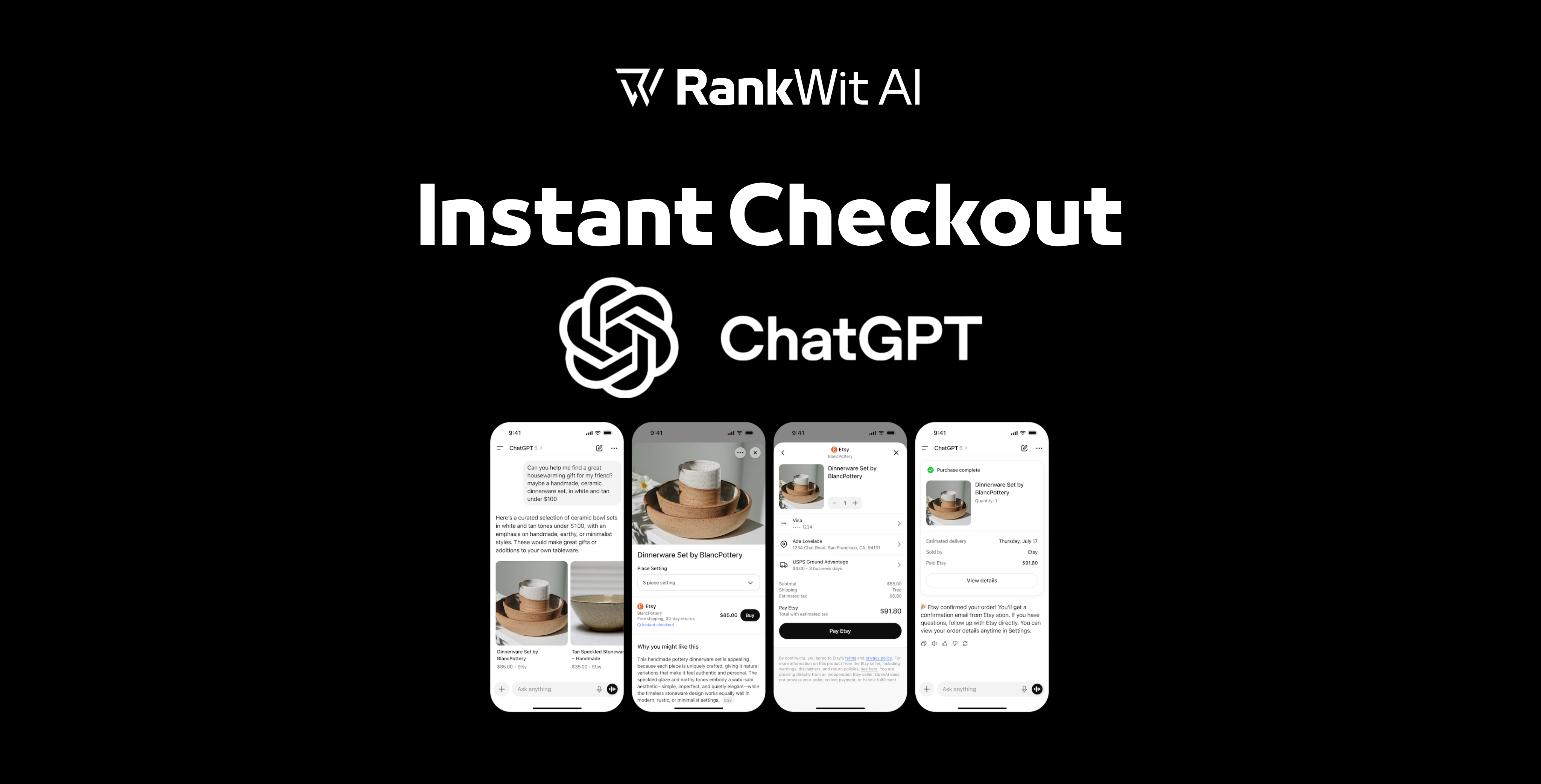
Does ChatGPT share my personal data with retailers when using Shopping Research?

Your privacy remains a priority when using Shopping Research.
ChatGPT does not send your personal information, queries, or preferences to retailers or third-party sites.

The tool simply gathers publicly available product information online, such as specifications, reviews, and prices, and organizes it into a personalized buyer’s guide for you.

You stay in full control, and no personal data is exchanged during the process.

Last updated at  
November 26, 2025
Other FAQ
Can I track multiple websites or brands?
Arrow

Absolutely. RankWit supports multi-website and multi-brand tracking:

  • Free: 1 website
  • Starter: up to 3website
  • Growth: Up to 10 websites
  • Business: Up to 50 websites
  • Enterprise: Unlimited websites

This makes RankWit ideal for agencies, SEO teams, or businesses managing multiple properties in one centralized dashboard.

Read More
ArrowArrow right blue
Is it difficult for developers to implement WebMCP on an existing website or application?
Arrow

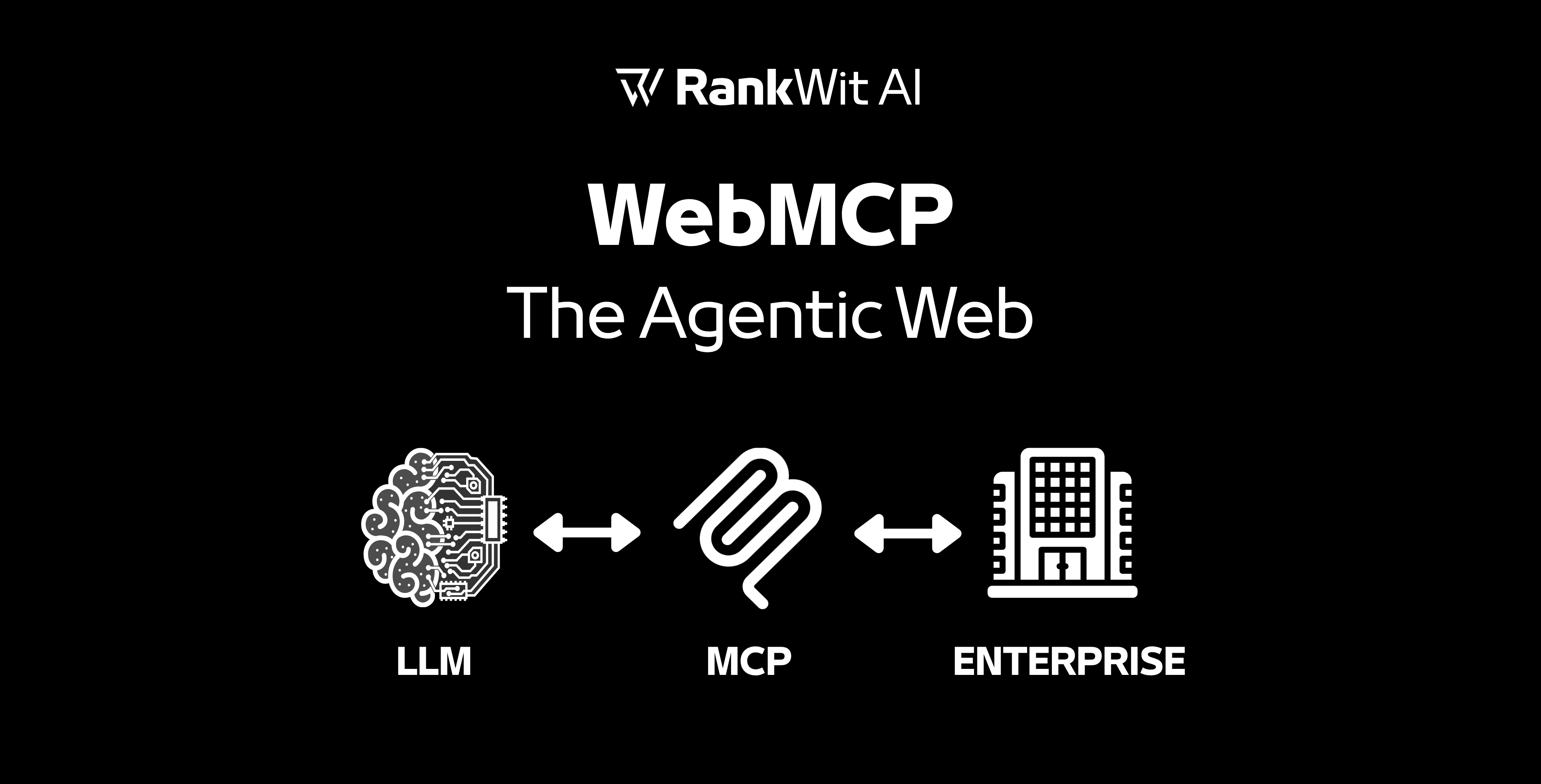
Implementing WebMCP is streamlined through the Google Chrome Labs toolkit. Developers have two primary paths:

  • Declarative: Simply add toolname and tooldescription attributes to existing HTML <form> tags.
  • Imperative: Use the navigator.modelContext.registerTool() API to expose complex JavaScript functions as callable AI tools.This flexibility allows teams to start with basic functionality and scale to complex integrations without a total architecture overhaul.

Read More
ArrowArrow right blue
Does RankWit support multiple countries?
Arrow

Yes! RankWit includes unlimited country tracking across all plans at no additional cost.
You can monitor AI visibility for any market worldwide.

Read More
ArrowArrow right blue
What are common mistakes in Generative Engine Optimization (GEO)?
Arrow

As businesses and content creators begin adapting to Generative Engine Optimization, it's crucial to recognize that strategies effective in traditional SEO don’t always translate to success with AI-driven search models like ChatGPT, Gemini, or Perplexity.

In fact, certain classic SEO practices can actually reduce your visibility in AI-generated answers.

In traditional SEO, the use of targeted keywords, often repeated strategically across headers, metadata, and body content, is a foundational tactic.
This approach helps search engine crawlers associate pages with specific queries, and has long been used to improve rankings on platforms like Google and Bing.

However, in the context of GEO, keyword stuffing and rigid repetition can backfire. indeed, Large Language Models (LLMs) are not keyword matchers, but they are pattern recognizers that prioritize natural, contextual, and semantically rich language.
When content is overly optimized and lacks a conversational or human tone, it becomes less appealing for AI models to cite or summarize.
Worse, it may signal to the model that the content is promotional or unnatural, leading to it being deprioritized in AI-generated responses.

ℹ️ Best Practice: Instead of focusing on exact-match keywords, create content that mirrors how real users ask questions. Use plain, fluent language and focus on fully answering likely user intents in a natural tone.

Moreover, while E-E-A-T (Experience, Expertise, Authority, Trustworthiness) has gained importance in SEO, it’s often still possible to rank SEO pages with minimal authority if technical and content signals are strong. This is less true in GEO.

LLMs are trained to surface and reference content that demonstrates a high degree of trustworthiness. They favor sources that reflect real-world experience, subject-matter expertise, and institutional authority. Content without clear authorship, lacking credentials, or failing to convey reliability may be ignored by LLMs, even if it’s optimized in other ways.

ℹ️ Best Practice: Build content that clearly communicates why your organization or author is credible. Include bios, cite credentials, and demonstrate hands-on knowledge. For health, finance, or scientific topics, link to institutional or peer-reviewed sources to reinforce authority.


In addition, in traditional SEO, especially in long-tail keyword spaces, some websites can rank with minimal sourcing or citations, particularly when competing against weak content. However, GEO demands higher factual rigor.
LLMs are designed to summarize and synthesize trusted data. They tend to skip over content that lacks citation, includes speculative claims, or refers to ambiguous sources.

Moreover, AI models have been trained on vast amounts of data from academic, journalistic, and institutional sources. This training impacts which sites and sources the models tend to favor when generating answers. Content without strong sourcing is less likely to be cited or retrieved via Retrieval-Augmented Generation (RAG) processes.

ℹ️ Best Practice: Always back your claims with authoritative, up-to-date sources. Link to original studies, well-known publications, or government and academic institutions. Inline citations and linked references increase your content’s reliability from an LLM’s perspective.

In short, while there is some overlap between SEO and GEO, optimizing for AI models requires a distinct strategy. The focus shifts from gaming algorithmic ranking systems to ensuring clarity, credibility, and accessibility for intelligent systems that mimic human understanding. To succeed in GEO, it's not enough to be visible to search engines—you must also be comprehensible, trustworthy, and useful to AI.

Read More
ArrowArrow right blue
Can I cancel my subscription at any time?
Arrow

Yes. You can cancel your subscription, downgrade, or upgrade your plan at any time.

Read More
ArrowArrow right blue
How can I optimize for GEO?
Arrow

GEO requires a shift in strategy from traditional SEO. Instead of focusing solely on how search engines crawl and rank pages, Generative Engine Optimization (GEO) focuses on how Large Language Models (LLMs) like ChatGPT, Gemini, or Claude understand, retrieve, and reproduce information in their answers.

To make this easier to implement, we can apply the three classic pillars of SEO—Semantic, Technical, and Authority/Links—reinterpreted through the lens of GEO.

1. Semantic Optimization (Text & Content Layer)

This refers to the language, structure, and clarity of the content itself—what you write and how you write it.

🧠 GEO Tactics:

  • Conversational Clarity: Use natural, question-answer formats that match how users interact with LLMs.
  • RAG-Friendly Layouts: Structure content so that models using Retrieval-Augmented Generation can easily locate and summarize it.
  • Authoritative Tone: Avoid vague or overly promotional language—LLMs favor clear, factual statements.
  • Structured Headers: Use H2s and H3s to define sections. LLMs rely heavily on this hierarchy for context segmentation.

🔍 Compared to Traditional SEO:

  • Similarity: Both value clarity, keyword-rich subheadings, and topic coverage.
  • Difference: GEO prioritizes contextual relevance and direct answers over keyword stuffing or search volume targeting.

2. Technical Optimization

This pillar deals with how your content is coded, delivered, and accessed—not just by humans, but by AI models too.

⚙️ GEO Tactics:

  • Structured Data (Schema Markup): Clearly define entities and relationships so LLMs can understand context.
  • Crawlability & Load Time: Still important, especially when LLMs like ChatGPT or Perplexity use live browsing.
  • Model-Friendly Formats: Prefer clean HTML, markdown, or plaintext—avoid heavy JavaScript that can block content visibility.
  • Zero-Click Readiness: Craft summaries and paragraphs that can stand alone, knowing the user may never visit your site.

🔍 Compared to Traditional SEO:

  • Similarity: Both benefit from clean code, fast performance, and schema markup.
  • Difference: GEO focuses on how readable and usable your content is for AI, not just browsers.

3. Authority & Link Strategy

This refers to the signals of trust that tell a model—or a search engine—that your content is reliable.

🔗 GEO Tactics:

  • Credible Sources: Reference reliable, third-party data (.gov, .edu, research papers). LLMs often echo content from trusted domains.
  • Internal Linking: Connect related content pieces to help LLMs understand topic depth and relationships.
  • Brand Mentions: Even unlinked brand citations across the web may boost your perceived credibility in LLMs’ training and inference models.

🔍 Compared to Traditional SEO:

  • Similarity: Both reward strong domain reputation and high-quality references.
  • Difference: GEO may rely more on accuracy and perceived authority across training data than on backlink volume or anchor text.

Read More
ArrowArrow right blue
How does RankWit track AI visibility?
Arrow

RankWit gives you a complete picture of how your brand appears across major AI platforms.
We run structured prompts through leading AI systems (including ChatGPT, Google AI Overview, and Perplexity) and then evaluate the responses for:

  • Brand mentions
  • Sentiment
  • Ranking or positioning
  • Competitor visibility
  • Opportunities and risks

This analysis helps you understand exactly how AI systems perceive and present your brand.

Read More
ArrowArrow right blue
How do Large Language Models (LLMs) like ChatGPT actually work?
Arrow

Large Language Models (LLMs) are AI systems trained on massive amounts of text data, from websites to books, to understand and generate language.

They use deep learning algorithms, specifically transformer architectures, to model the structure and meaning of language.

LLMs don't "know" facts in the way humans do. Instead, they predict the next word in a sequence using probabilities, based on the context of everything that came before it. This ability enables them to produce fluent and relevant responses across countless topics.

For a deeper look at the mechanics, check out our full blog post: How Large Language Models Work.

Read More
ArrowArrow right blue
What kind of optimization recommendations does RankWit provide?
Arrow

RankWit analyzes your existing content and gives actionable, data-backed recommendations for improving your AI visibility. Suggestions include:

  • Rewriting sentences to be more concise and AI-parsable
  • Restructuring content into formats AI engines prefer (e.g., lists, FAQs, summaries)
  • Highlighting authority signals, such as including stats, sources, or clear claims
    These optimizations are designed to increase the chances that AI platforms surface your content over competitors’.

Read More
ArrowArrow right blue
What is AI Search Optimization and why is it important?
Arrow

AI Search Optimization refers to the practice of structuring, formatting, and presenting digital content to ensure it is surfaced by AI systems—particularly large language models (LLMs)—in response to user queries.Choosing a clear, unified name for this emerging field is crucial because it shapes professional standards, guides tool development, informs marketing strategies, and fosters a cohesive community of practice. Without a consistent term, the industry risks fragmentation and inefficiency, much like early digital marketing faced before "SEO" was widely adopted.

Read More
ArrowArrow right blue

📚 Learn, Apply, Win

Stay inspired with the latest stories, tips, and insights.
Explore articles designed to spark ideas, share knowledge, and keep you updated on what’s new.