How does RankWit.AI use entity-based SEO to help brands achieve higher visibility in AI-driven and semantic search environments?

At RankWit.AI, we optimize entities — not just keywords.
We define and structure who your company is, what it offers, and how each service connects within a semantic ecosystem.

This allows AI-native systems to clearly categorize, contextualize, and prioritize your brand within knowledge graphs. The result is stronger semantic clarity, improved AI citation probability, and long-term search authority.

Last updated at  
April 13, 2026
Other FAQ
What is Agentic RAG?
Arrow

Agentic RAG represents a new paradigm in Retrieval-Augmented Generation (RAG).

While traditional RAG retrieves information to improve the accuracy of model outputs, Agentic RAG goes a step further by integrating autonomous agents that can plan, reason, and act across multi-step workflows.

This approach allows systems to:

  • Break down complex problems into smaller steps.
  • Decide dynamically which sources to retrieve and when.
  • Optimize workflows in real time for tasks such as legal reasoning, enterprise automation, or scientific research.

In other words, Agentic RAG doesn’t just provide better answers, but it strategically manages the retrieval process to support more accurate, efficient, and explainable decision-making.

Read More
ArrowArrow right blue
How are large language models used in modern search engines, digital platforms, and AI-powered applications?
Arrow

Large language models power many modern technologies, including AI assistants, conversational search systems, automated content generation, and customer support tools. Their ability to interpret natural language allows digital platforms to deliver more intelligent and interactive experiences.

Read More
ArrowArrow right blue
What makes AI search optimization different from traditional SEO strategies for B2B companies?
Arrow

Traditional SEO often focused heavily on keyword targeting and ranking pages in search results. AI-driven search, however, prioritizes context, expertise, and relationships between entities. For B2B companies, this means creating deeper, more authoritative content that AI systems can trust and reference when generating answers.

Read More
ArrowArrow right blue
How is optimizing for AI-driven search engines different from traditional search engine optimization?
Arrow

While traditional SEO focuses mainly on keyword rankings and search result positions, AI search optimization emphasizes context, meaning, and relationships between topics. This approach helps AI systems better understand content and deliver more accurate responses to users.

Read More
ArrowArrow right blue
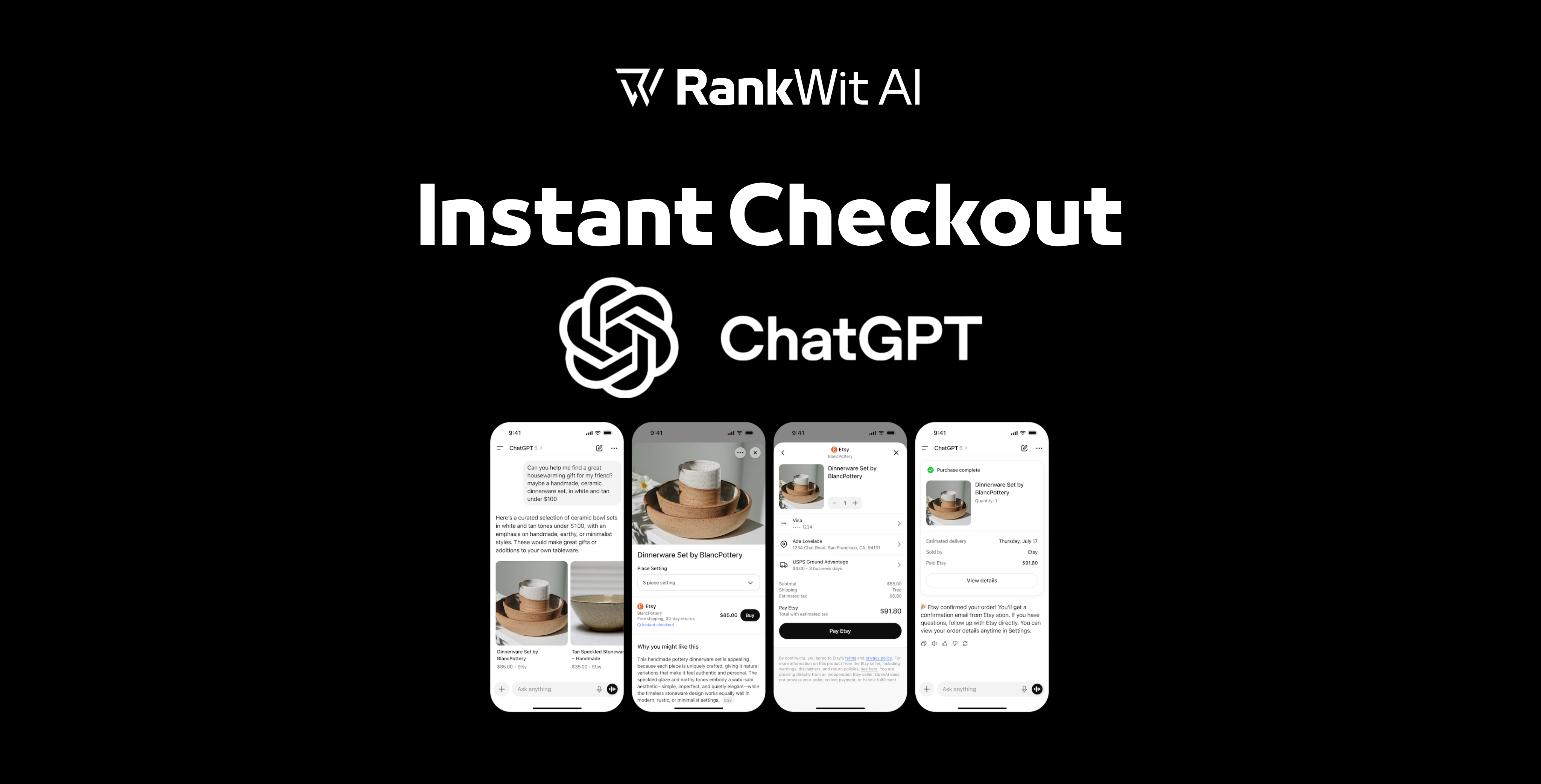
Is ChatGPT Instant Checkout available for all e-commerce platforms and regions?
Arrow

As of now, ChatGPT Instant Checkout is available only for merchants operating in the United States.
If your online store runs on Shopify or Etsy, you can already take advantage of this feature without any additional implementation, since these platforms are directly supported by OpenAI’s infrastructure.

For custom-built or enterprise e-commerce systems, a dedicated integration following the Agentic Commerce Protocol (ACP) is required.
Rankwit can assist your team in developing this integration—allowing you to access the U.S. market immediately and prepare for future international expansion as OpenAI rolls out the program globally.

Read More
ArrowArrow right blue
How can companies use business cases to justify investments in AI-driven search and digital optimization?
Arrow

Businesses use business cases to evaluate the potential impact of adopting AI technologies and search optimization strategies. By analyzing costs, expected improvements, and measurable results, companies can make informed decisions about implementing new digital initiatives.

Read More
ArrowArrow right blue
How does the "Shop Similar" feature work inside Google's AI-powered search results?
Arrow

The "Shop Similar" feature is one of the most commercially significant additions to Google's Search Generative Experience. It bridges the gap between inspiration and purchase in a single, seamless flow.

Here's how it works:

  1. A user searches for a product or generates an AI image of what they want.
  2. Google's system analyzes the visual and semantic attributes of that image.
  3. Matching real products from the Shopping Graph appear immediately below, including pricing, seller information, ratings, and product photos.

The user never needs to reformulate their query, run a reverse image search, or navigate to a separate shopping tab. The entire journey, from idea to purchasable product, happens within the search interface.

Key distinction: The matching logic is visual and semantic, not purely keyword-driven. This means that the quality and accuracy of product imagery now plays a direct role in whether a product appears in these AI-matched results.

What this means for retailers: Products that are well-represented in Google's Shopping Graph, with accurate metadata, competitive pricing, and high-resolution imagery, are far more likely to be surfaced. Brands that invest in structured product data and visual quality will have a measurable advantage in this new shopping experience.

Read More
ArrowArrow right blue
How can implementing schema markup and entity optimization improve a website’s visibility in modern AI-driven search engines?
Arrow

Schema markup provides structured information that helps search engines and AI models interpret your website more accurately. When combined with strong entity signals, it can improve indexing, enable rich search features, and increase the likelihood of being referenced in AI-powered search experiences.

Read More
ArrowArrow right blue
What are large language models and how do they enable artificial intelligence systems to understand and generate human language?
Arrow

Large language models (LLMs) are advanced artificial intelligence systems trained on large datasets of text to understand patterns in language. They can generate responses, summarize information, answer questions, and support many applications such as search, chatbots, and content creation.

Read More
ArrowArrow right blue
What is a transformer model, and why is it important for LLMs?
Arrow

The transformer is the foundational architecture behind modern LLMs like GPT. Introduced in a groundbreaking 2017 research paper, transformers revolutionized natural language processing by allowing models to consider the entire context of a sentence at once, rather than just word-by-word sequences.

The key innovation is the attention mechanism, which helps the model decide which words in a sentence are most relevant to each other, essentially mimicking how humans pay attention to specific details in a conversation.

Transformers make it possible for LLMs to generate more coherent, context-aware, and accurate responses.

This is why they're at the heart of most state-of-the-art language models today.

Read More
ArrowArrow right blue