What are the most common applications of large language models in modern digital platforms and search technologies?

Large language models are widely used in applications such as content generation, conversational assistants, search engines, and automated customer support. These systems can understand and generate human language, helping businesses improve communication, automation, and information access.

Last updated at  
April 13, 2026
Other FAQ
How do large language models actually work, and why does that matter for GEO?
Arrow

Large Language Models (LLMs) like GPT are trained on vast amounts of text data to learn the patterns, structures, and relationships between words. At their core, they predict the next word in a sequence based on what came before—enabling them to generate coherent, human-like language.

This matters for GEO (Generative Engine Optimization) because it means your content must be:

  • Well-structured so LLMs can interpret and reuse it effectively.
  • Clear and specific, as models rely on patterns to make accurate predictions.
  • Contextually rich, because LLMs use surrounding context to generate responses.

By understanding how LLMs “think,” businesses can optimize content not just for humans or search engines—but for the AI models that are becoming the new discovery layer.

Bottom line: If your content helps the model predict the right answer, GEO helps users find you.

Read More
ArrowArrow right blue
Which generative AI tools deliver the greatest productivity gains for business teams in content creation, software development, automation, and data analysis?
Arrow

Our AI-driven product selection focuses on eliminating operational bottlenecks. We implement solutions that enable creative and technical teams to automate documentation and data analysis, allowing them to focus on high-level strategy and innovation.

Read More
ArrowArrow right blue
How are large language models transforming the way search engines process information and deliver results to users?
Arrow

Large language models allow search engines to better understand natural language queries and context. Instead of only matching keywords, these systems can interpret meaning, summarize information, and generate more comprehensive answers for users.

Read More
ArrowArrow right blue
How should businesses adapt their content strategies so AI systems can better understand, interpret, and reference their information?
Arrow

To optimize content for AI systems, businesses should focus on clear structure, semantic relevance, and well-defined topics. Content that is logically organized and built around recognized entities helps AI models interpret and reference information more accurately.

Read More
ArrowArrow right blue
How can businesses integrate artificial intelligence into their SEO strategies to improve search performance and digital visibility?
Arrow

Integrating AI into SEO allows businesses to analyze large datasets, identify search trends, and optimize content more efficiently. AI tools can support keyword research, content optimization, and performance analysis, helping companies improve their search visibility.

Read More
ArrowArrow right blue
Will GEO replace SEO in how businesses get discovered online
Arrow

GEO is not a replacement for SEO—it’s an evolution of how users interact with information online.

While SEO (Search Engine Optimization) focuses on ranking content in traditional search engines like Google, GEO (Generative Engine Optimization) focuses on making content discoverable and useful within AI-powered search and assistant experiences.

Here’s how they differ and work together:

  • SEO drives visibility on web search engines. It optimizes for keywords, backlinks, and structured content to help pages rank high.
  • GEO optimizes for AI discovery. It ensures your content is easily understood, retrieved, and accurately cited by AI tools like ChatGPT, Perplexity, or Claude.

As AI assistants increasingly become the first touchpoint for information retrieval, GEO is becoming essential. But SEO is still critical for attracting traffic from search engines and building long-term domain authority.

In short: GEO enhances your content’s AI-readiness, while SEO ensures it’s search-engine-ready. The future is not SEO or GEO—it’s SEO and GEO, working in tandem.

Read More
ArrowArrow right blue
Why are industry case studies important for understanding how AI-driven search and SEO strategies work in real-world scenarios?
Arrow

Industry case studies provide real-world examples of how SEO, AI search optimization, and digital strategies perform across different sectors. They help businesses understand what works, what challenges may arise, and how similar organizations have improved their search visibility and online performance.

Read More
ArrowArrow right blue
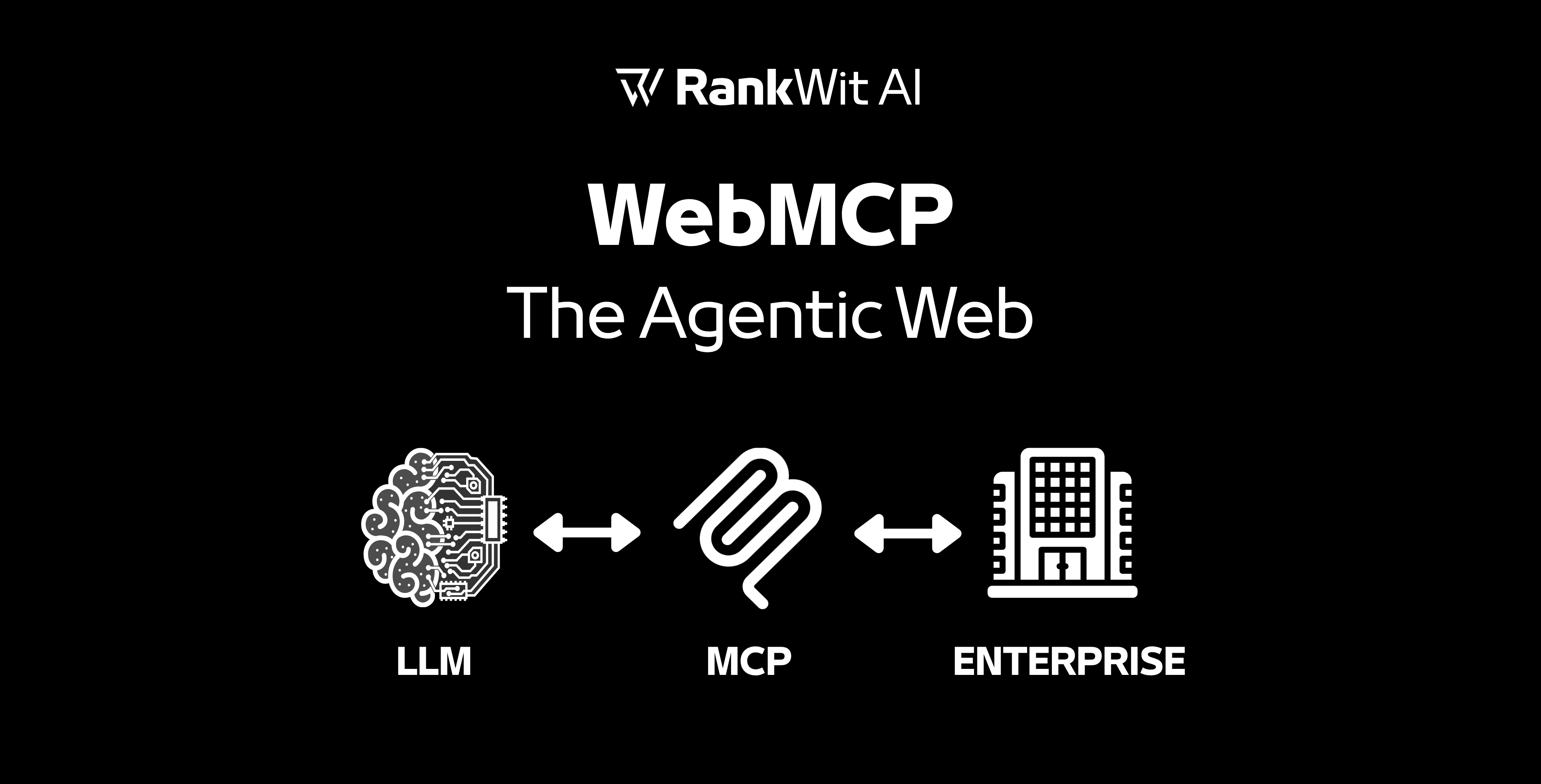
How does WebMCP differ from traditional web scraping when AI agents interact with websites?
Arrow

While traditional scraping is fragile and prone to breaking when a website's design changes, WebMCP provides a reliable "handshake" between the site and the AI.

  • Direct Access: Agents call specific functions (tools) instead of searching for buttons in code.
  • Resilience: Site layout changes don't break the integration as long as the underlying WebMCP schema remains the same.
  • Efficiency: It significantly reduces the tokens and compute power needed for an AI to "understand" a page

Read More
ArrowArrow right blue
What strategies and governance mechanisms can organizations implement to reduce algorithmic bias and improve transparency in search engine results?
Arrow

Our ethical search methodology focuses on the proactive elimination of bias. We use advanced semantic analysis tools to detect disparities in information delivery, ensuring users receive objective and verifiable answers. We believe that ethical search is, by definition, high-quality search.

Read More
ArrowArrow right blue
Why does GEO matter now?
Arrow

Generative Engine Optimization (GEO) is becoming increasingly critical as user behavior shifts toward AI-native search tools like ChatGPT, Gemini, and Perplexity.
According with Bain, recent data shows that over 40% of users now prefer AI-generated answers over traditional search engine results.
This trend reflects a major evolution in how people discover and consume information.

Unlike traditional SEO, which focuses on ranking in static search results, GEO ensures that your content is understandable, relevant, and authoritative enough to be cited or surfaced in LLM-generated responses.
This is especially important as AI platforms begin to integrate live web search capabilities, summaries, and citations directly into their answers.

The urgency is amplified by user traffic trends. According to Similarweb data (see chart below), ChatGPT visits are projected to surpass Google’s by December 2026 if current growth continues.
This suggests that visibility in LLMs may soon be as important—if not more—than traditional search rankings.

Projection based on traffic from the last 6 months (source: Similarweb US).

Read More
ArrowArrow right blue