How are LLMs trained to understand and generate human-like text?

Training a Large Language Model involves feeding it enormous volumes of text data, from books and blogs to academic papers and web content.

This data is tokenized (split into smaller parts like words or subwords), and then processed through multiple layers of a deep learning model.

Over time, the model learns statistical relationships between words and phrases. For example, it learns that “coffee” often appears near “morning” or “caffeine.” These associations help the model generate text that feels intuitive and human.

Once the base training is done, models are often fine-tuned using additional data and human feedback to improve accuracy, tone, and usefulness. The result: a powerful tool that understands language well enough to assist with everything from SEO optimization to natural conversation.

Last updated at  
April 8, 2026
Other FAQ
In che modo i rivenditori e gli esperti di marketing dovrebbero adattare la loro strategia alle funzionalità di Generative AI Shopping di Google?
Arrow

Le funzionalità Generative AI Shopping di Google stanno ridefinendo il percorso dalla scoperta del prodotto all'acquisto. Per i rivenditori e gli esperti di marketing, ciò richiede un cambiamento strategico in diverse aree:

Investi nella qualità visiva

Con prodotti corrispondenti «Shop Similar» basati sull'intelligenza artificiale basati su somiglianza visiva e semantica piuttosto che le sole parole chiave, la qualità delle immagini dei prodotti non è mai stata così importante. Le foto a bassa risoluzione, gli sfondi non coerenti o le immagini che non rappresentano accuratamente il prodotto saranno svantaggiate.

Procedura ottimale: Usa fotografie di prodotto pulite e ad alta risoluzione. Assicurati che le immagini rappresentino accuratamente colori, texture e proporzioni, poiché il motore di abbinamento AI valuta direttamente questi attributi.

Ottimizza la presenza di Shopping Graph

Shopping Graph di Google, un set di dati di oltre 35 miliardi di elenchi di prodotti aggiornato continuamente, è la spina dorsale di ogni funzionalità di acquisto basata sull'intelligenza artificiale. I prodotti incompleti, obsoleti o mancanti semplicemente non verranno visualizzati nei risultati generati dall'intelligenza artificiale.

Procedura ottimale: Mantieni aggiornati i feed dei prodotti con titoli, descrizioni, prezzi, disponibilità e attributi strutturati accurati. Tratta Shopping Graph come un'infrastruttura critica, non come un'operazione secondaria.

Preparati per le domande conversazionali

Man mano che gli utenti imparano a descrivere i prodotti in linguaggio naturale (ad esempio, «regali per un bambino di 7 anni che vuole diventare un inventore»), il comportamento di ricerca si sposterà verso query più lunghe e descrittive. Si tratta di domande che l'intelligenza artificiale generativa eccelle nell'interpretazione.

Procedura ottimale: Crea descrizioni dei prodotti e contenuti di categoria che rispecchiano il modo in cui le persone reali parlano dei tuoi prodotti. Concentrati su casi d'uso, scenari e attributi specifici anziché su testi di marketing generici.

Monitora il traffico riferito dall'IA

Secondo Adobe Analytics, il traffico dagli strumenti di intelligenza artificiale generativa ai siti web di vendita al dettaglio è cresciuto 1.200% anno su anno all'inizio del 2025, con visitatori che mostrano sessioni più lunghe, più visualizzazioni di pagina e frequenze di rimbalzo inferiori. Pur rappresentando ancora una piccola quota del traffico totale, la traiettoria di crescita è ripida.

Procedura ottimale: Tieni traccia del traffico riferito all'intelligenza artificiale come canale distinto nelle tue analisi. Scopri quali prodotti e categorie vengono messi in evidenza dagli strumenti di intelligenza artificiale e ottimizza di conseguenza.

Conclusione: Il passaggio dalla ricerca per parole chiave alla ricerca generativa basata sull'intelligenza artificiale non è un evento futuro. I rivenditori che adattano i dati di prodotto, le risorse visive e la strategia dei contenuti saranno ora in grado di catturare la quota crescente di intenzioni di acquisto che scaturiscono dalla scoperta basata sull'intelligenza artificiale.

Read More
ArrowArrow right blue
How do large language models actually work, and why does that matter for GEO?
Arrow

Large Language Models (LLMs) like GPT are trained on vast amounts of text data to learn the patterns, structures, and relationships between words. At their core, they predict the next word in a sequence based on what came before—enabling them to generate coherent, human-like language.

This matters for GEO (Generative Engine Optimization) because it means your content must be:

  • Well-structured so LLMs can interpret and reuse it effectively.
  • Clear and specific, as models rely on patterns to make accurate predictions.
  • Contextually rich, because LLMs use surrounding context to generate responses.

By understanding how LLMs “think,” businesses can optimize content not just for humans or search engines—but for the AI models that are becoming the new discovery layer.

Bottom line: If your content helps the model predict the right answer, GEO helps users find you.

Read More
ArrowArrow right blue
Cos'è la prova virtuale basata sull'intelligenza artificiale di Google per lo shopping e quali categorie di prodotti supporta?
Arrow

Prova virtuale basata sull'intelligenza artificiale di Google è una funzionalità di Google Shopping che utilizza AI generativa per mostrare l'aspetto di un capo specifico su un modello reale che corrisponde alle preferenze dell'acquirente.

Gli utenti possono scegliere tra 40 modelli che variano in:

  • Tonalità della pelle
  • Forma del corpo
  • Altezza e dimensioni

Questo aiuta gli acquirenti a prendere decisioni di acquisto più sicure senza recarsi in un negozio fisico, risolvendo uno dei maggiori punti di attrito nello shopping di abbigliamento online: incertezza sulla vestibilità e sull'aspetto.

Copertura attuale:

  • Top da donna (lanciato per primo, con centinaia di marchi supportati)
  • Top da uomo (ampliato alla fine del 2023, con marchi come Abercrombie, Banana Republic, J.Crew e Under Armour)

Google ha riferito che i prodotti con la prova virtuale abilitata hanno ricevuto coinvolgimento di qualità significativamente superiore, il che significa che gli acquirenti trascorrevano più tempo a interagire con quelle inserzioni ed erano più propensi a intraprendere azioni come fare clic o effettuare un acquisto.

Perché è importante per la strategia GEO e di e-commerce: Man mano che Google estende la prova virtuale ad altre categorie, i marchi che partecipano al programma forniscono immagini di prodotto standardizzate e di alta qualità trarrà beneficio da segnali di coinvolgimento più forti e da un maggiore potenziale di conversione. Questa funzione è un chiaro indicatore che la qualità dei contenuti visivi sta diventando un fattore di ranking in esperienze di acquisto basate sull'intelligenza artificiale.

Read More
ArrowArrow right blue
What is a transformer model, and why is it important for LLMs?
Arrow

The transformer is the foundational architecture behind modern LLMs like GPT. Introduced in a groundbreaking 2017 research paper, transformers revolutionized natural language processing by allowing models to consider the entire context of a sentence at once, rather than just word-by-word sequences.

The key innovation is the attention mechanism, which helps the model decide which words in a sentence are most relevant to each other, essentially mimicking how humans pay attention to specific details in a conversation.

Transformers make it possible for LLMs to generate more coherent, context-aware, and accurate responses.

This is why they're at the heart of most state-of-the-art language models today.

Read More
ArrowArrow right blue
What is ChatGPT Instant Checkout and how does it work for e-commerce merchants?
Arrow

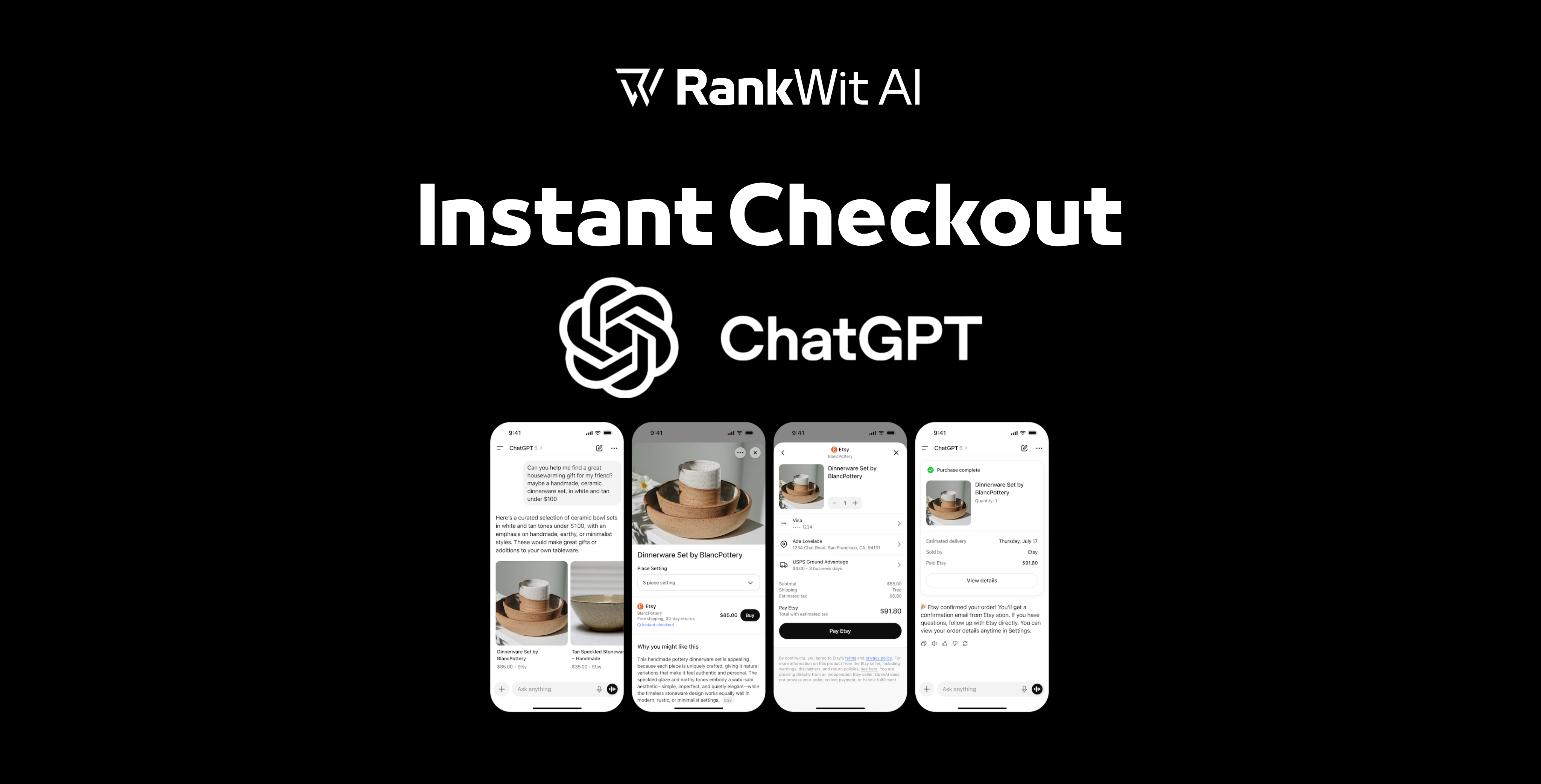
ChatGPT Instant Checkout is a new capability since 2025 developed by OpenAI that allows users to discover, configure, and purchase products directly within ChatGPT without leaving the conversation.
This functionality is powered by the Agentic Commerce Protocol (ACP), an open standard that defines how merchants’ systems interact with AI agents.

Merchants connect their product catalog through a structured product feed, expose checkout endpoints via the Agentic Checkout API, and process payments securely through delegated payment providers like Stripe.
Together, these layers create a smooth, conversational shopping experience that merges AI discovery with secure e-commerce execution.

Read More
ArrowArrow right blue
Does RankWit support multiple countries?
Arrow

Yes! RankWit includes unlimited country tracking across all plans at no additional cost.
You can monitor AI visibility for any market worldwide.

Read More
ArrowArrow right blue
What are common mistakes in Generative Engine Optimization (GEO)?
Arrow

As businesses and content creators begin adapting to Generative Engine Optimization, it's crucial to recognize that strategies effective in traditional SEO don’t always translate to success with AI-driven search models like ChatGPT, Gemini, or Perplexity.

In fact, certain classic SEO practices can actually reduce your visibility in AI-generated answers.

In traditional SEO, the use of targeted keywords, often repeated strategically across headers, metadata, and body content, is a foundational tactic.
This approach helps search engine crawlers associate pages with specific queries, and has long been used to improve rankings on platforms like Google and Bing.

However, in the context of GEO, keyword stuffing and rigid repetition can backfire. indeed, Large Language Models (LLMs) are not keyword matchers, but they are pattern recognizers that prioritize natural, contextual, and semantically rich language.
When content is overly optimized and lacks a conversational or human tone, it becomes less appealing for AI models to cite or summarize.
Worse, it may signal to the model that the content is promotional or unnatural, leading to it being deprioritized in AI-generated responses.

ℹ️ Best Practice: Instead of focusing on exact-match keywords, create content that mirrors how real users ask questions. Use plain, fluent language and focus on fully answering likely user intents in a natural tone.

Moreover, while E-E-A-T (Experience, Expertise, Authority, Trustworthiness) has gained importance in SEO, it’s often still possible to rank SEO pages with minimal authority if technical and content signals are strong. This is less true in GEO.

LLMs are trained to surface and reference content that demonstrates a high degree of trustworthiness. They favor sources that reflect real-world experience, subject-matter expertise, and institutional authority. Content without clear authorship, lacking credentials, or failing to convey reliability may be ignored by LLMs, even if it’s optimized in other ways.

ℹ️ Best Practice: Build content that clearly communicates why your organization or author is credible. Include bios, cite credentials, and demonstrate hands-on knowledge. For health, finance, or scientific topics, link to institutional or peer-reviewed sources to reinforce authority.


In addition, in traditional SEO, especially in long-tail keyword spaces, some websites can rank with minimal sourcing or citations, particularly when competing against weak content. However, GEO demands higher factual rigor.
LLMs are designed to summarize and synthesize trusted data. They tend to skip over content that lacks citation, includes speculative claims, or refers to ambiguous sources.

Moreover, AI models have been trained on vast amounts of data from academic, journalistic, and institutional sources. This training impacts which sites and sources the models tend to favor when generating answers. Content without strong sourcing is less likely to be cited or retrieved via Retrieval-Augmented Generation (RAG) processes.

ℹ️ Best Practice: Always back your claims with authoritative, up-to-date sources. Link to original studies, well-known publications, or government and academic institutions. Inline citations and linked references increase your content’s reliability from an LLM’s perspective.

In short, while there is some overlap between SEO and GEO, optimizing for AI models requires a distinct strategy. The focus shifts from gaming algorithmic ranking systems to ensuring clarity, credibility, and accessibility for intelligent systems that mimic human understanding. To succeed in GEO, it's not enough to be visible to search engines—you must also be comprehensible, trustworthy, and useful to AI.

Read More
ArrowArrow right blue
How is GEO different from SEO?
Arrow

GEO (Generative Engine Optimization) is not a rebrand of SEO—it’s a response to an entirely new environment. SEO optimizes for bots that crawl, index, and rank. GEO optimizes for large language models (LLMs) that read, learn, and generate human-like answers.

While SEO is built around keywords and backlinks, GEO is about semantic clarity, contextual authority, and conversational structuring. You're not trying to please an algorithm—you’re helping an AI understand and echo your ideas accurately in its responses. It's not just about being found—it's about being spoken for.

Read More
ArrowArrow right blue
Is ChatGPT Instant Checkout available for all e-commerce platforms and regions?
Arrow

As of now, ChatGPT Instant Checkout is available only for merchants operating in the United States.
If your online store runs on Shopify or Etsy, you can already take advantage of this feature without any additional implementation, since these platforms are directly supported by OpenAI’s infrastructure.

For custom-built or enterprise e-commerce systems, a dedicated integration following the Agentic Commerce Protocol (ACP) is required.
Rankwit can assist your team in developing this integration—allowing you to access the U.S. market immediately and prepare for future international expansion as OpenAI rolls out the program globally.

Read More
ArrowArrow right blue
What export formats are available?
Arrow

RankWit makes reporting simple.
You can export all tracking data in multiple formats, including:

  • PDF
  • CSV
  • Word documents
  • Custom reporting templates

This makes sharing insights with clients or leadership fast and flexible.

Read More
ArrowArrow right blue