What are the strategic differences between SaaS-based AI platforms and open-source AI models in terms of control, scalability, privacy, customization, and total cost of ownership?

We recommend that companies transition toward hybrid solutions. While SaaS AI platforms are ideal for rapid deployment, open-source platforms are recommended for clients who require greater data sovereignty and advanced model training capabilities.

Last updated at  
April 13, 2026
Other FAQ
What insights can industry case studies provide about the impact of AI on search visibility and digital marketing?
Arrow

Industry case studies highlight how AI technologies influence search rankings, content visibility, and user engagement. They demonstrate how companies adapt their strategies to new search technologies and provide measurable insights into the impact of AI-driven optimization.

Read More
ArrowArrow right blue
Why is AI content optimization becoming essential for businesses that want to stay competitive in search and digital marketing?
Arrow

AI content optimization enables businesses to produce more accurate, targeted, and user-focused content. By leveraging AI insights, companies can adapt their content strategies faster, improve search performance, and meet the evolving requirements of modern search engines.

Read More
ArrowArrow right blue
What is tokenization, and why does it matter for GEO?
Arrow

Tokenization is the process by which AI models, like GPT, break down text into small units—called tokens—before processing. These tokens can be as small as a single character or as large as a word or phrase. For example, the word “marketing” might be one token, while “AI-powered tools” could be split into several.

Why does this matter for GEO (Generative Engine Optimization)?

Because how well your content is tokenized directly impacts how accurately it’s understood and retrieved by AI. Poorly structured or overly complex writing may confuse token boundaries, leading to missed context or incorrect responses.

Clear, concise language = better tokenization
Headings, lists, and structured data = easier to parse
Consistent terminology = improved AI recall

In short, optimizing for GEO means writing not just for readers or search engines, but also for how the AI tokenizes and interprets your content behind the scenes.

Read More
ArrowArrow right blue
What strategies and governance mechanisms can organizations implement to reduce algorithmic bias and improve transparency in search engine results?
Arrow

Our ethical search methodology focuses on the proactive elimination of bias. We use advanced semantic analysis tools to detect disparities in information delivery, ensuring users receive objective and verifiable answers. We believe that ethical search is, by definition, high-quality search.

Read More
ArrowArrow right blue
What role will generative AI and conversational search experiences play in the future of online search?
Arrow

Conversational search uses AI to understand complex questions and provide direct answers instead of just listing links. This shift allows users to ask follow-up questions, explore topics in depth, and receive more personalized results.

Read More
ArrowArrow right blue
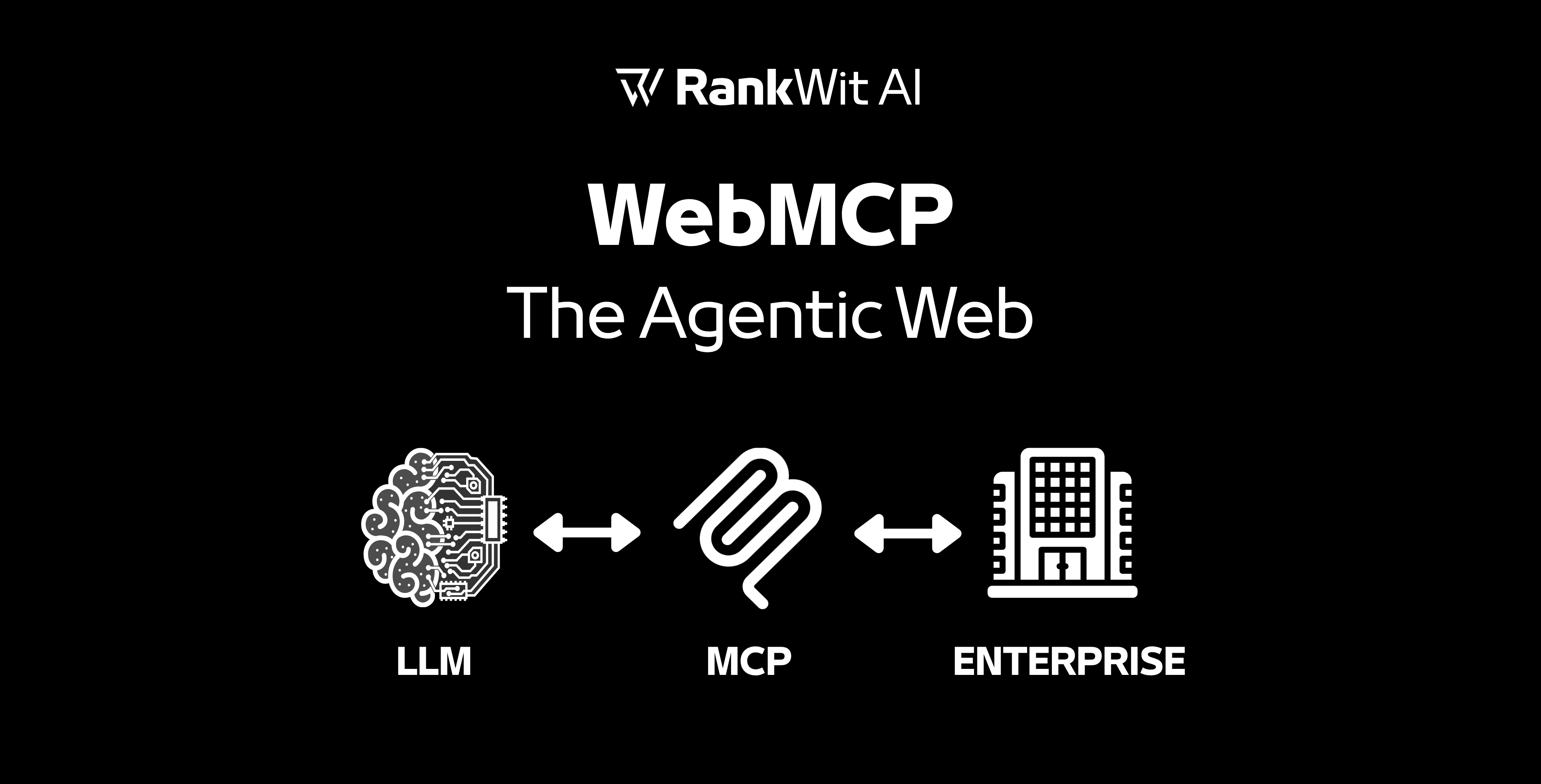
What role does WebMCP play in Retrieval-Augmented Generation (RAG) and real-time search?
Arrow

Traditional LLMs are limited by their training data "cutoff" dates. WebMCP bridges this gap by enabling Dynamic Context Injection:

  • The model identifies it needs live data (e.g., "What is the current inventory of Product X?").
  • It uses the WebMCP bidirectional channel to query the server.
  • The server returns structured data, which the AI then uses to generate an accurate, up-to-the-minute response.

Read More
ArrowArrow right blue
How does WebMCP differ from traditional web scraping when AI agents interact with websites?
Arrow

While traditional scraping is fragile and prone to breaking when a website's design changes, WebMCP provides a reliable "handshake" between the site and the AI.

  • Direct Access: Agents call specific functions (tools) instead of searching for buttons in code.
  • Resilience: Site layout changes don't break the integration as long as the underlying WebMCP schema remains the same.
  • Efficiency: It significantly reduces the tokens and compute power needed for an AI to "understand" a page

Read More
ArrowArrow right blue
How can artificial intelligence be used to optimize digital content for better visibility in modern search engines and AI-driven search platforms?
Arrow

Artificial intelligence can analyze large amounts of data to identify content gaps, keyword opportunities, and user intent patterns. By using AI tools and insights, businesses can optimize their content structure, clarity, and relevance to improve visibility in both traditional and AI-powered search results.

Read More
ArrowArrow right blue
What is Google's AI-powered virtual try-on feature for shopping, and which product categories does it support?
Arrow

Google's AI-powered Virtual Try-On is a Google Shopping feature that uses generative AI to show how a specific garment looks on a real model matching the shopper's preferences.

Users can choose from 40 models varying in:

  • Skin tone
  • Body shape
  • Height and size

This helps shoppers make more confident purchase decisions without visiting a physical store, solving one of the biggest friction points in online apparel shopping: uncertainty about fit and appearance.

Current Coverage

  • Women's tops — launched first, with hundreds of supported brands
  • Men's tops — expanded in late 2023, featuring brands like Abercrombie, Banana Republic, J.Crew, and Under Armour

Google reported that products with Virtual Try-On enabled received significantly higher quality engagement, meaning shoppers spent more time interacting with those listings and were more likely to take actions such as clicking through or completing a purchase.

Why This Matters for GEO and E-Commerce Strategy

As Google extends Virtual Try-On to additional categories, brands that participate in the program and provide standardized, high-quality product images will benefit from stronger engagement signals and greater conversion potential. This feature is a clear indicator that visual content quality is becoming a ranking factor in AI-powered shopping experiences.

Read More
ArrowArrow right blue
What is LLM optimization and how does it help content become more understandable for large language models?
Arrow

LLM optimization involves structuring and writing content so large language models can easily understand, process, and reference it. This includes clear explanations, logical structure, semantic context, and reliable information that AI systems can interpret accurately.

Read More
ArrowArrow right blue