Why is it important for local businesses to optimize their online presence for AI-driven local search platforms?

As search engines increasingly rely on AI, local businesses must ensure their data is accurate, structured, and consistent across platforms. Optimizing business profiles, location information, and local content helps AI systems better understand and recommend businesses to nearby users

Last updated at  
April 13, 2026
Other FAQ
What trends will shape the next generation of LLM optimization strategies?
Arrow

Future LLM optimization strategies will focus on semantic understanding, strong entity signals, structured knowledge, and high-quality information sources. These trends will help AI systems deliver more accurate and context-aware responses.

Read More
ArrowArrow right blue
How does structured data help search engines and AI systems better understand the content and context of a website?
Arrow

Structured data uses standardized formats like schema markup to explain the meaning of your content to search engines. This allows platforms like Google and AI-powered search systems to better interpret your pages, connect them with relevant entities, and potentially display enhanced results such as rich snippets or knowledge panels.

Read More
ArrowArrow right blue
How can I optimize for GEO?
Arrow

GEO requires a shift in strategy from traditional SEO. Instead of focusing solely on how search engines crawl and rank pages, Generative Engine Optimization (GEO) focuses on how Large Language Models (LLMs) like ChatGPT, Gemini, or Claude understand, retrieve, and reproduce information in their answers.

To make this easier to implement, we can apply the three classic pillars of SEO—Semantic, Technical, and Authority/Links—reinterpreted through the lens of GEO.

1. Semantic Optimization (Text & Content Layer)

This refers to the language, structure, and clarity of the content itself—what you write and how you write it.

🧠 GEO Tactics:

  • Conversational Clarity: Use natural, question-answer formats that match how users interact with LLMs.
  • RAG-Friendly Layouts: Structure content so that models using Retrieval-Augmented Generation can easily locate and summarize it.
  • Authoritative Tone: Avoid vague or overly promotional language—LLMs favor clear, factual statements.
  • Structured Headers: Use H2s and H3s to define sections. LLMs rely heavily on this hierarchy for context segmentation.

🔍 Compared to Traditional SEO:

  • Similarity: Both value clarity, keyword-rich subheadings, and topic coverage.
  • Difference: GEO prioritizes contextual relevance and direct answers over keyword stuffing or search volume targeting.

2. Technical Optimization

This pillar deals with how your content is coded, delivered, and accessed—not just by humans, but by AI models too.

⚙️ GEO Tactics:

  • Structured Data (Schema Markup): Clearly define entities and relationships so LLMs can understand context.
  • Crawlability & Load Time: Still important, especially when LLMs like ChatGPT or Perplexity use live browsing.
  • Model-Friendly Formats: Prefer clean HTML, markdown, or plaintext—avoid heavy JavaScript that can block content visibility.
  • Zero-Click Readiness: Craft summaries and paragraphs that can stand alone, knowing the user may never visit your site.

🔍 Compared to Traditional SEO:

  • Similarity: Both benefit from clean code, fast performance, and schema markup.
  • Difference: GEO focuses on how readable and usable your content is for AI, not just browsers.

3. Authority & Link Strategy

This refers to the signals of trust that tell a model—or a search engine—that your content is reliable.

🔗 GEO Tactics:

  • Credible Sources: Reference reliable, third-party data (.gov, .edu, research papers). LLMs often echo content from trusted domains.
  • Internal Linking: Connect related content pieces to help LLMs understand topic depth and relationships.
  • Brand Mentions: Even unlinked brand citations across the web may boost your perceived credibility in LLMs’ training and inference models.

🔍 Compared to Traditional SEO:

  • Similarity: Both reward strong domain reputation and high-quality references.
  • Difference: GEO may rely more on accuracy and perceived authority across training data than on backlink volume or anchor text.

Read More
ArrowArrow right blue
What are the main types of search intent and how do they influence SEO and content strategies?
Arrow

Search intent is commonly divided into informational, navigational, commercial, and transactional categories. Recognizing these intent types helps businesses design content that aligns with user goals, improving visibility and engagement in search results.

Read More
ArrowArrow right blue
How can Rankwit help my business integrate with ChatGPT’s Agentic Commerce Protocol?
Arrow

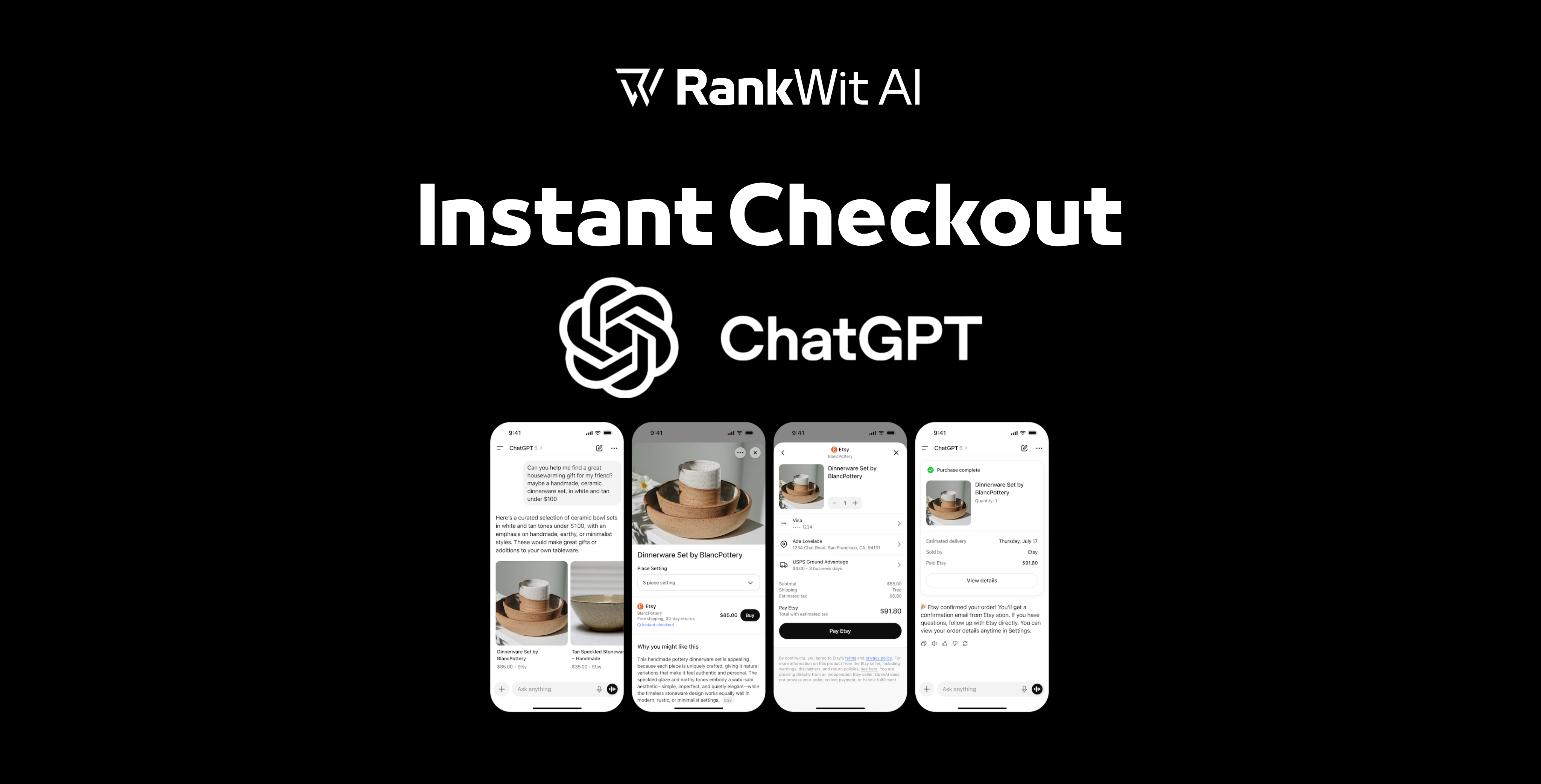
At Rankwit, we specialize in helping merchants take advantage of OpenAI’s Agentic Commerce Protocol (ACP).
Our team manages the entire integration lifecycle, from mapping your product catalog to OpenAI’s structured feed specification, to building the checkout API endpoints and connecting secure payment providers like Stripe.

By partnering with Rankwit, your business can:

  • Launch AI-powered conversational shopping experiences inside ChatGPT.
  • Achieve full compliance with OpenAI and PCI DSS standards.
  • Gain an unfair competitive advantage by adopting this technology before it becomes mainstream.

We tailor solutions to both enterprise and custom e-commerce platforms, ensuring a scalable and future-ready architecture.

Read More
ArrowArrow right blue
Why is optimizing product data and content important for visibility in AI-powered e-commerce search systems?
Arrow

AI-powered search engines rely on structured product information, clear descriptions, and relevant attributes to interpret and categorize products. Well-optimized product data improves visibility in search results and increases the chances of products being recommended to potential buyers.

Read More
ArrowArrow right blue
How are RankWit credits calculated?
Arrow

Credits determine how much AI tracking you perform.
A single credit = 1 prompt × 1 AI model.

For example:

  • 10 prompts
  • × 3 AI models (ChatGPT, Google AI Overview, Perplexity)
    = 30 credits

This transparent system ensures you only pay for the tracking you use.

Read More
ArrowArrow right blue
What is AI Search Optimization and why is it important?
Arrow

AI Search Optimization refers to the practice of structuring, formatting, and presenting digital content to ensure it is surfaced by AI systems—particularly large language models (LLMs)—in response to user queries.Choosing a clear, unified name for this emerging field is crucial because it shapes professional standards, guides tool development, informs marketing strategies, and fosters a cohesive community of practice. Without a consistent term, the industry risks fragmentation and inefficiency, much like early digital marketing faced before "SEO" was widely adopted.

Read More
ArrowArrow right blue
Will GEO replace SEO in how businesses get discovered online
Arrow

GEO is not a replacement for SEO—it’s an evolution of how users interact with information online.

While SEO (Search Engine Optimization) focuses on ranking content in traditional search engines like Google, GEO (Generative Engine Optimization) focuses on making content discoverable and useful within AI-powered search and assistant experiences.

Here’s how they differ and work together:

  • SEO drives visibility on web search engines. It optimizes for keywords, backlinks, and structured content to help pages rank high.
  • GEO optimizes for AI discovery. It ensures your content is easily understood, retrieved, and accurately cited by AI tools like ChatGPT, Perplexity, or Claude.

As AI assistants increasingly become the first touchpoint for information retrieval, GEO is becoming essential. But SEO is still critical for attracting traffic from search engines and building long-term domain authority.

In short: GEO enhances your content’s AI-readiness, while SEO ensures it’s search-engine-ready. The future is not SEO or GEO—it’s SEO and GEO, working in tandem.

Read More
ArrowArrow right blue
Who can benefit the most from using RankWit?
Arrow

RankWit is designed for anyone who wants to maximize their brand’s visibility on AI platforms. The main users include:

- Freelancers: Stand out by offering clients AI-optimized content services.
- Agencies: Add GEO to your service portfolio and stay ahead of competitors.
- Brands: Protect and expand your presence so that AI cites your company, not someone else’s.

Whether you work independently or as part of a larger marketing team, RankWit provides tools to monitor, optimize, and grow in the age of AI search.

Read More
ArrowArrow right blue