How does the "Shop Similar" feature work inside Google's AI-powered search results?

The "Shop Similar" feature is one of the most commercially significant additions to Google's Search Generative Experience. It bridges the gap between inspiration and purchase in a single, seamless flow.

Here's how it works:

  1. A user searches for a product or generates an AI image of what they want.
  2. Google's system analyzes the visual and semantic attributes of that image.
  3. Matching real products from the Shopping Graph appear immediately below, including pricing, seller information, ratings, and product photos.

The user never needs to reformulate their query, run a reverse image search, or navigate to a separate shopping tab. The entire journey, from idea to purchasable product, happens within the search interface.

Key distinction: The matching logic is visual and semantic, not purely keyword-driven. This means that the quality and accuracy of product imagery now plays a direct role in whether a product appears in these AI-matched results.

What this means for retailers: Products that are well-represented in Google's Shopping Graph, with accurate metadata, competitive pricing, and high-resolution imagery, are far more likely to be surfaced. Brands that invest in structured product data and visual quality will have a measurable advantage in this new shopping experience.

Last updated at  
April 8, 2026
Other FAQ
How are RankWit credits calculated?
Arrow

Credits determine how much AI tracking you perform.
A single credit = 1 prompt × 1 AI model.

For example:

  • 10 prompts
  • × 3 AI models (ChatGPT, Google AI Overview, Perplexity)
    = 30 credits

This transparent system ensures you only pay for the tracking you use.

Read More
ArrowArrow right blue
How long does setup take?
Arrow

Setup takes only a few minutes.
Just add your website, configure your prompts and RankWit begins analyzing your AI visibility immediately.

Read More
ArrowArrow right blue
How is GEO different from SEO?
Arrow

GEO (Generative Engine Optimization) is not a rebrand of SEO—it’s a response to an entirely new environment. SEO optimizes for bots that crawl, index, and rank. GEO optimizes for large language models (LLMs) that read, learn, and generate human-like answers.

While SEO is built around keywords and backlinks, GEO is about semantic clarity, contextual authority, and conversational structuring. You're not trying to please an algorithm—you’re helping an AI understand and echo your ideas accurately in its responses. It's not just about being found—it's about being spoken for.

Read More
ArrowArrow right blue
Is ChatGPT Instant Checkout available for all e-commerce platforms and regions?
Arrow

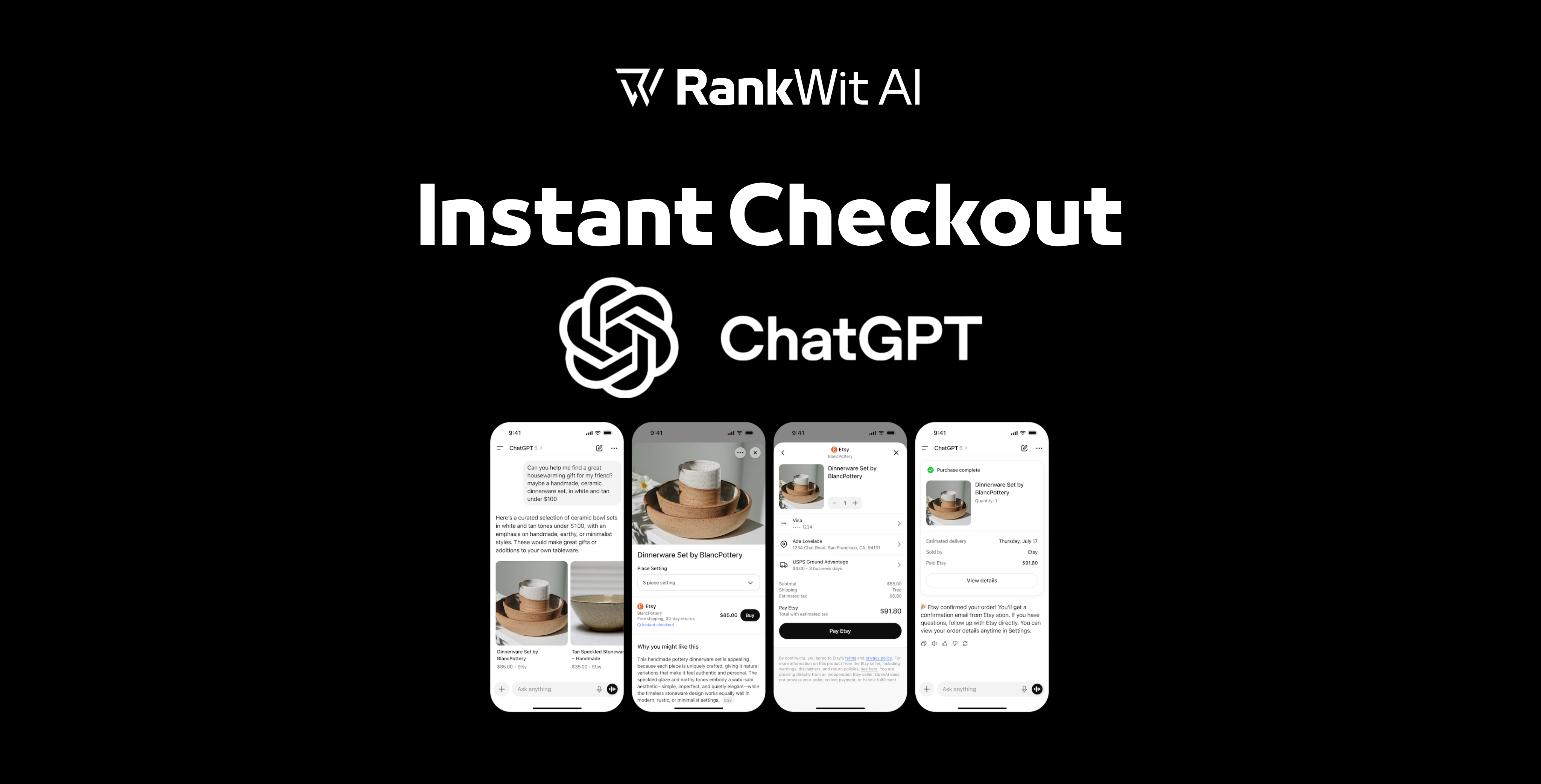
As of now, ChatGPT Instant Checkout is available only for merchants operating in the United States.
If your online store runs on Shopify or Etsy, you can already take advantage of this feature without any additional implementation, since these platforms are directly supported by OpenAI’s infrastructure.

For custom-built or enterprise e-commerce systems, a dedicated integration following the Agentic Commerce Protocol (ACP) is required.
Rankwit can assist your team in developing this integration—allowing you to access the U.S. market immediately and prepare for future international expansion as OpenAI rolls out the program globally.

Read More
ArrowArrow right blue
What kind of optimization recommendations does RankWit provide?
Arrow

RankWit analyzes your existing content and gives actionable, data-backed recommendations for improving your AI visibility. Suggestions include:

  • Rewriting sentences to be more concise and AI-parsable
  • Restructuring content into formats AI engines prefer (e.g., lists, FAQs, summaries)
  • Highlighting authority signals, such as including stats, sources, or clear claims
    These optimizations are designed to increase the chances that AI platforms surface your content over competitors’.

Read More
ArrowArrow right blue
How are LLMs trained to understand and generate human-like text?
Arrow

Training a Large Language Model involves feeding it enormous volumes of text data, from books and blogs to academic papers and web content.

This data is tokenized (split into smaller parts like words or subwords), and then processed through multiple layers of a deep learning model.

Over time, the model learns statistical relationships between words and phrases. For example, it learns that “coffee” often appears near “morning” or “caffeine.” These associations help the model generate text that feels intuitive and human.

Once the base training is done, models are often fine-tuned using additional data and human feedback to improve accuracy, tone, and usefulness. The result: a powerful tool that understands language well enough to assist with everything from SEO optimization to natural conversation.

Read More
ArrowArrow right blue
What is AI Search Optimization and why is it important?
Arrow

AI Search Optimization refers to the practice of structuring, formatting, and presenting digital content to ensure it is surfaced by AI systems—particularly large language models (LLMs)—in response to user queries.Choosing a clear, unified name for this emerging field is crucial because it shapes professional standards, guides tool development, informs marketing strategies, and fosters a cohesive community of practice. Without a consistent term, the industry risks fragmentation and inefficiency, much like early digital marketing faced before "SEO" was widely adopted.

Read More
ArrowArrow right blue
What is a business case and why is it important for evaluating AI and search optimization strategies?
Arrow

A business case outlines the objectives, benefits, costs, and potential outcomes of implementing a specific strategy or technology. In the context of AI and search optimization, it helps organizations understand the expected value, risks, and return on investment before adopting new solutions.

Read More
ArrowArrow right blue
How can Rankwit help my business integrate with ChatGPT’s Agentic Commerce Protocol?
Arrow

At Rankwit, we specialize in helping merchants take advantage of OpenAI’s Agentic Commerce Protocol (ACP).
Our team manages the entire integration lifecycle, from mapping your product catalog to OpenAI’s structured feed specification, to building the checkout API endpoints and connecting secure payment providers like Stripe.

By partnering with Rankwit, your business can:

  • Launch AI-powered conversational shopping experiences inside ChatGPT.
  • Achieve full compliance with OpenAI and PCI DSS standards.
  • Gain an unfair competitive advantage by adopting this technology before it becomes mainstream.

We tailor solutions to both enterprise and custom e-commerce platforms, ensuring a scalable and future-ready architecture.

Read More
ArrowArrow right blue
Which plan should I choose: Starter, Growth, or Enterprise?
Arrow

RankWit plans are designed to scale with your needs:

  • Starter: Best for freelancers, consultants, and small agencies beginning with AI visibility tracking.
  • Growth: Great for established agencies, marketing teams, and organizations with multiple websites.
  • Enterprise: Built for large companies needing advanced customization, higher credit volumes, and dedicated support.

If you’re unsure, we can help you select the best plan based on your tracking volume and team size.

Read More
ArrowArrow right blue