📚 Learn, Apply, Win
Explore articles designed to spark ideas, share knowledge, and keep you updated on what’s new.
Artificial intelligence is improving e-commerce search by understanding user intent, preferences, and behavior. AI systems can recommend relevant products, interpret natural language queries, and personalize results, helping customers discover products more efficiently.
AI Search Optimization refers to the practice of structuring, formatting, and presenting digital content to ensure it is surfaced by AI systems—particularly large language models (LLMs)—in response to user queries.Choosing a clear, unified name for this emerging field is crucial because it shapes professional standards, guides tool development, informs marketing strategies, and fosters a cohesive community of practice. Without a consistent term, the industry risks fragmentation and inefficiency, much like early digital marketing faced before "SEO" was widely adopted.
RAG (Retrieval-Augmented Generation) is a cutting-edge AI technique that enhances traditional language models by integrating an external search or knowledge retrieval system. Instead of relying solely on pre-trained data, a RAG-enabled model can search a database or knowledge source in real time and use the results to generate more accurate, contextually relevant answers.
For GEO, this is a game changer.
GEO doesn't just respond with generic language—it retrieves fresh, relevant insights from your company’s knowledge base, documents, or external web content before generating its reply. This means:
By combining the strengths of generation and retrieval, RAG ensures GEO doesn't just sound smart—it is smart, aligned with your source of truth.
Structured data uses standardized formats like schema markup to explain the meaning of your content to search engines. This allows platforms like Google and AI-powered search systems to better interpret your pages, connect them with relevant entities, and potentially display enhanced results such as rich snippets or knowledge panels.
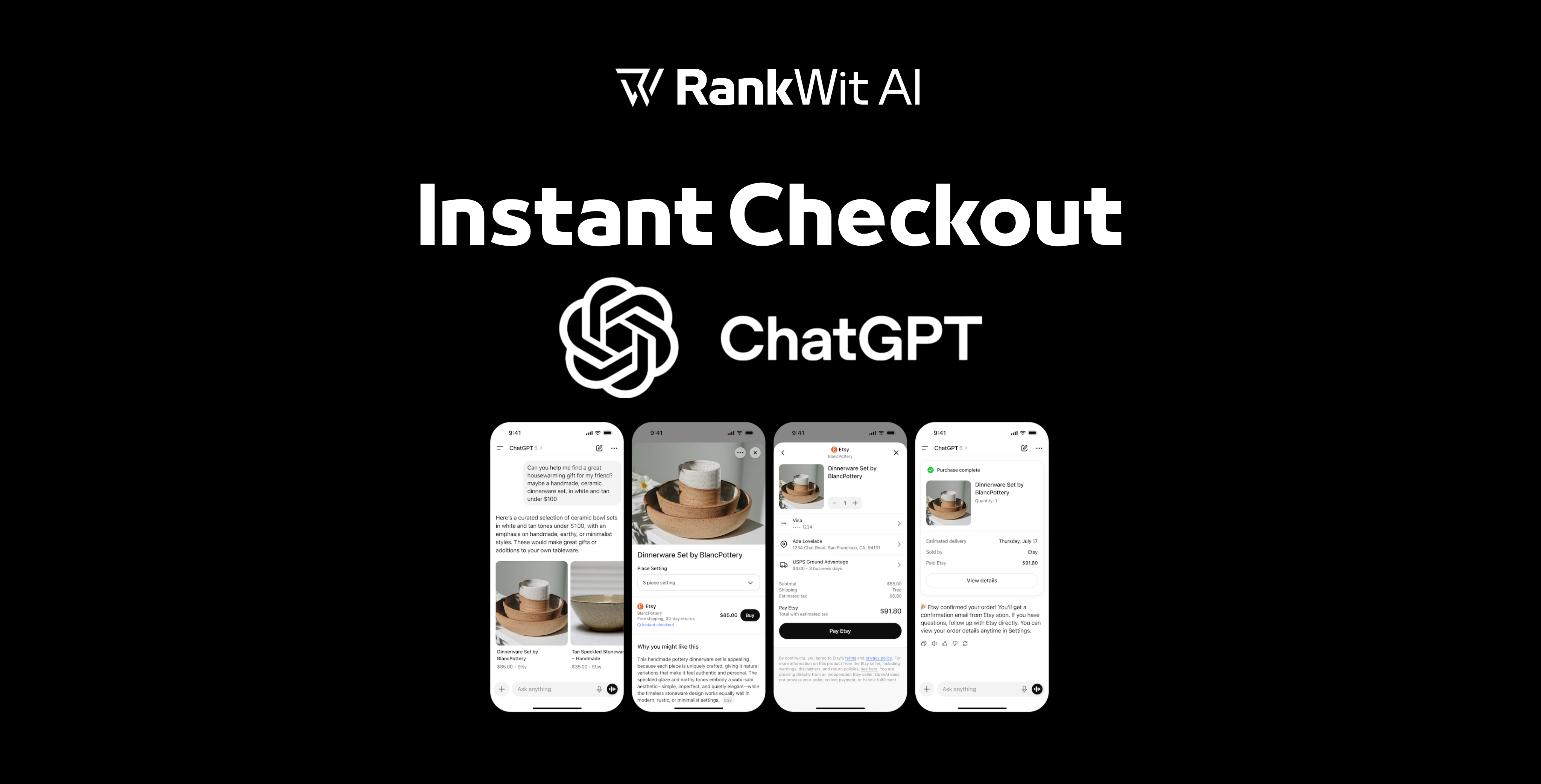
At Rankwit, we specialize in helping merchants take advantage of OpenAI’s Agentic Commerce Protocol (ACP).
Our team manages the entire integration lifecycle, from mapping your product catalog to OpenAI’s structured feed specification, to building the checkout API endpoints and connecting secure payment providers like Stripe.
By partnering with Rankwit, your business can:
We tailor solutions to both enterprise and custom e-commerce platforms, ensuring a scalable and future-ready architecture.
AI governance in search engines refers to the rules, policies, and practices that ensure artificial intelligence systems operate in a fair, transparent, safe, and responsible way. It includes managing data use, reducing bias, protecting user privacy, and making sure search results are accurate and trustworthy.
At RankWit.AI, we optimize entities — not just keywords.
We define and structure who your company is, what it offers, and how each service connects within a semantic ecosystem.
This allows AI-native systems to clearly categorize, contextualize, and prioritize your brand within knowledge graphs. The result is stronger semantic clarity, improved AI citation probability, and long-term search authority.
RankWit gives you a complete picture of how your brand appears across major AI platforms.
We run structured prompts through leading AI systems (including ChatGPT, Google AI Overview, and Perplexity) and then evaluate the responses for:
This analysis helps you understand exactly how AI systems perceive and present your brand.