What key trends are shaping the future of search engines as large language models become more widely integrated?

As large language models become integrated into search engines, major trends include conversational search interfaces, AI-generated summaries, deeper semantic understanding, and more personalized results. These changes are redefining how users interact with search platforms.

Last updated at  
April 13, 2026
Other FAQ
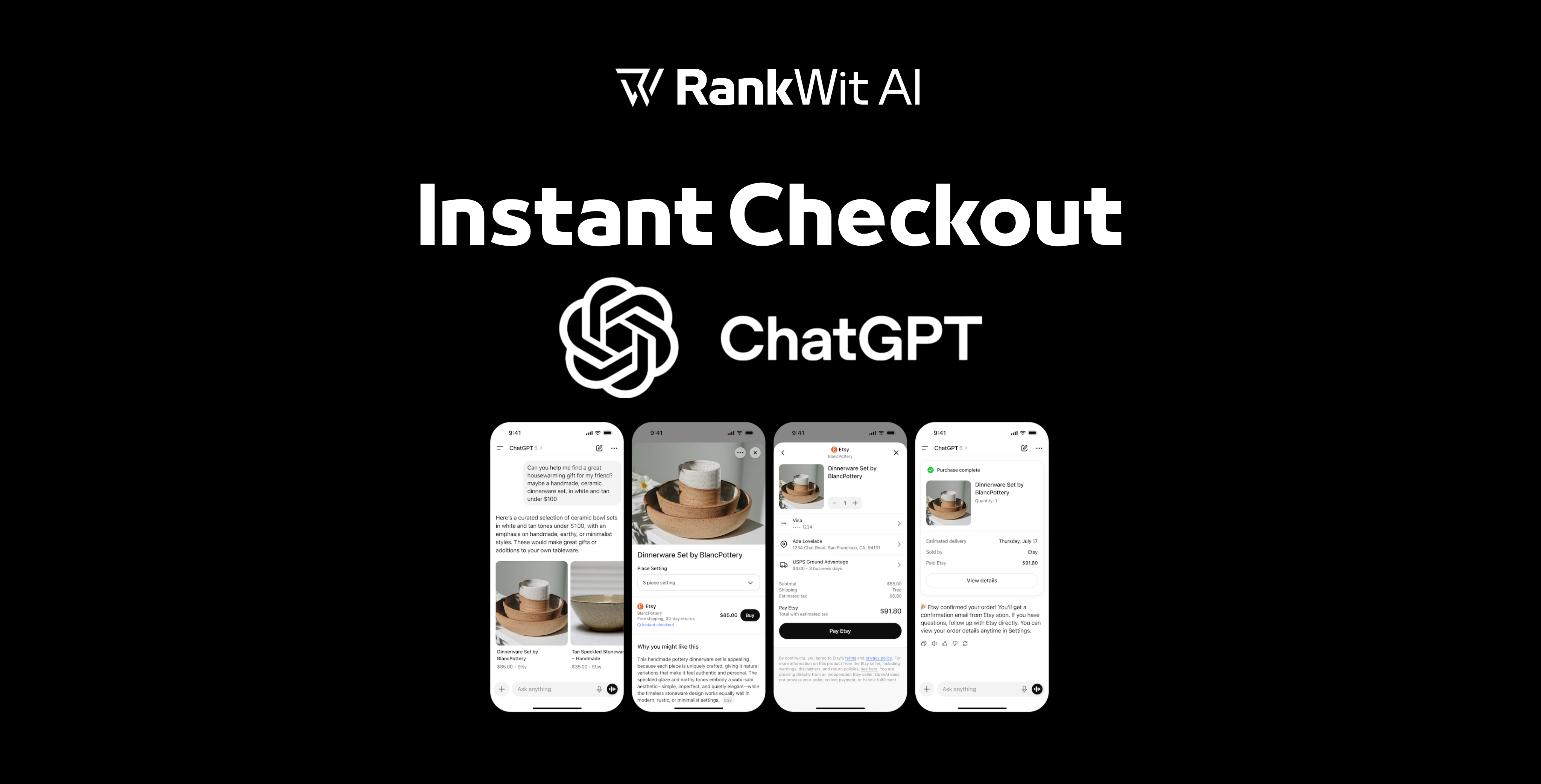
Is ChatGPT Instant Checkout available for all e-commerce platforms and regions?
Arrow

As of now, ChatGPT Instant Checkout is available only for merchants operating in the United States.
If your online store runs on Shopify or Etsy, you can already take advantage of this feature without any additional implementation, since these platforms are directly supported by OpenAI’s infrastructure.

For custom-built or enterprise e-commerce systems, a dedicated integration following the Agentic Commerce Protocol (ACP) is required.
Rankwit can assist your team in developing this integration—allowing you to access the U.S. market immediately and prepare for future international expansion as OpenAI rolls out the program globally.

Read More
ArrowArrow right blue
What criteria should organizations use to evaluate and select the most suitable AI platform for scalability, performance, security, and long-term return on investment?
Arrow

Within our ecosystem, we evaluate AI platforms based on real profitability criteria. We do not simply look for the most popular infrastructure, but for platforms that offer robust APIs, enterprise-grade data security, and native integration with existing systems to ensure immediate return on investment.

Read More
ArrowArrow right blue
How can artificial intelligence be used to optimize digital content for better visibility in modern search engines and AI-driven search platforms?
Arrow

Artificial intelligence can analyze large amounts of data to identify content gaps, keyword opportunities, and user intent patterns. By using AI tools and insights, businesses can optimize their content structure, clarity, and relevance to improve visibility in both traditional and AI-powered search results.

Read More
ArrowArrow right blue
What is tokenization, and why does it matter for GEO?
Arrow

Tokenization is the process by which AI models, like GPT, break down text into small units—called tokens—before processing. These tokens can be as small as a single character or as large as a word or phrase. For example, the word “marketing” might be one token, while “AI-powered tools” could be split into several.

Why does this matter for GEO (Generative Engine Optimization)?

Because how well your content is tokenized directly impacts how accurately it’s understood and retrieved by AI. Poorly structured or overly complex writing may confuse token boundaries, leading to missed context or incorrect responses.

Clear, concise language = better tokenization
Headings, lists, and structured data = easier to parse
Consistent terminology = improved AI recall

In short, optimizing for GEO means writing not just for readers or search engines, but also for how the AI tokenizes and interprets your content behind the scenes.

Read More
ArrowArrow right blue
How are RankWit credits calculated?
Arrow

Credits determine how much AI tracking you perform.
A single credit = 1 prompt × 1 AI model.

For example:

  • 10 prompts
  • × 3 AI models (ChatGPT, Google AI Overview, Perplexity)
    = 30 credits

This transparent system ensures you only pay for the tracking you use.

Read More
ArrowArrow right blue
How can businesses use industry case studies to improve their own AI search and SEO strategies?
Arrow

By analyzing industry case studies, businesses can learn from proven strategies, understand emerging trends, and identify opportunities to improve their own digital presence. These insights help companies make more informed decisions when adapting to AI-powered search environments.

Read More
ArrowArrow right blue
How can companies use business cases to justify investments in AI-driven search and digital optimization?
Arrow

Businesses use business cases to evaluate the potential impact of adopting AI technologies and search optimization strategies. By analyzing costs, expected improvements, and measurable results, companies can make informed decisions about implementing new digital initiatives.

Read More
ArrowArrow right blue
How can websites structure their content so it can be effectively retrieved and used by Retrieval-Augmented Generation systems?
Arrow

Content that is well-structured, informative, and organized around clear topics is easier for retrieval systems to access and use. Structured headings, semantic clarity, and authoritative information increase the chances that content will be retrieved and used by AI systems during response generation.

Read More
ArrowArrow right blue
What types of literature are most useful for professionals working with AI-driven search and digital optimization?
Arrow

Professionals working with AI-driven search benefit from reviewing academic studies, technical papers, and industry reports. These sources provide evidence-based insights that help explain how search technologies evolve and how optimization strategies should adapt.

Read More
ArrowArrow right blue
What is ChatGPT Shopping Research and how does it work?
Arrow

Shopping Research is a feature in ChatGPT that acts as a personalized shopping assistant.
Simply describe what you’re looking for, such as “a lightweight laptop for travel”, and ChatGPT gathers product details, reviews, specs, prices, and comparisons from the web.

You can refine the results by marking products as “Not interested” or “More like this”, helping ChatGPT understand your preferences.

At the end, you receive a custom buyer’s guide that explains the pros, cons, and trade-offs of each option, making your purchase process easier and more informed.

Read More
ArrowArrow right blue