What types of literature are most useful for professionals working with AI-driven search and digital optimization?

Professionals working with AI-driven search benefit from reviewing academic studies, technical papers, and industry reports. These sources provide evidence-based insights that help explain how search technologies evolve and how optimization strategies should adapt.

Last updated at  
April 8, 2026
Other FAQ
How do Large Language Models (LLMs) like ChatGPT actually work?
Arrow

Large Language Models (LLMs) are AI systems trained on massive amounts of text data, from websites to books, to understand and generate language.

They use deep learning algorithms, specifically transformer architectures, to model the structure and meaning of language.

LLMs don't "know" facts in the way humans do. Instead, they predict the next word in a sequence using probabilities, based on the context of everything that came before it. This ability enables them to produce fluent and relevant responses across countless topics.

For a deeper look at the mechanics, check out our full blog post: How Large Language Models Work.

Read More
ArrowArrow right blue
What is ChatGPT Instant Checkout and how does it work for e-commerce merchants?
Arrow

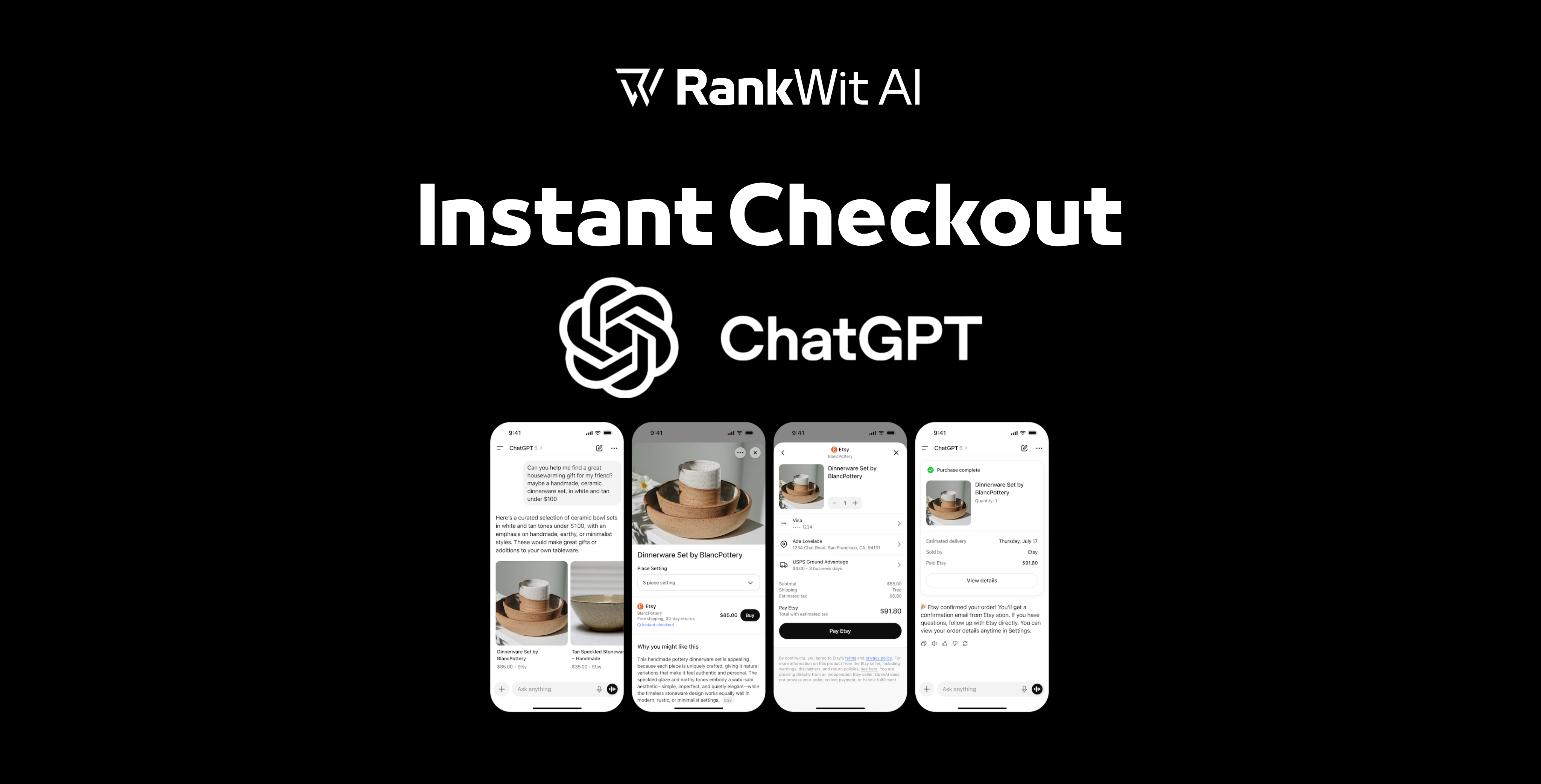
ChatGPT Instant Checkout is a new capability since 2025 developed by OpenAI that allows users to discover, configure, and purchase products directly within ChatGPT without leaving the conversation.
This functionality is powered by the Agentic Commerce Protocol (ACP), an open standard that defines how merchants’ systems interact with AI agents.

Merchants connect their product catalog through a structured product feed, expose checkout endpoints via the Agentic Checkout API, and process payments securely through delegated payment providers like Stripe.
Together, these layers create a smooth, conversational shopping experience that merges AI discovery with secure e-commerce execution.

Read More
ArrowArrow right blue
In che modo i rivenditori e gli esperti di marketing dovrebbero adattare la loro strategia alle funzionalità di Generative AI Shopping di Google?
Arrow

Le funzionalità Generative AI Shopping di Google stanno ridefinendo il percorso dalla scoperta del prodotto all'acquisto. Per i rivenditori e gli esperti di marketing, ciò richiede un cambiamento strategico in diverse aree:

Investi nella qualità visiva

Con prodotti corrispondenti «Shop Similar» basati sull'intelligenza artificiale basati su somiglianza visiva e semantica piuttosto che le sole parole chiave, la qualità delle immagini dei prodotti non è mai stata così importante. Le foto a bassa risoluzione, gli sfondi non coerenti o le immagini che non rappresentano accuratamente il prodotto saranno svantaggiate.

Procedura ottimale: Usa fotografie di prodotto pulite e ad alta risoluzione. Assicurati che le immagini rappresentino accuratamente colori, texture e proporzioni, poiché il motore di abbinamento AI valuta direttamente questi attributi.

Ottimizza la presenza di Shopping Graph

Shopping Graph di Google, un set di dati di oltre 35 miliardi di elenchi di prodotti aggiornato continuamente, è la spina dorsale di ogni funzionalità di acquisto basata sull'intelligenza artificiale. I prodotti incompleti, obsoleti o mancanti semplicemente non verranno visualizzati nei risultati generati dall'intelligenza artificiale.

Procedura ottimale: Mantieni aggiornati i feed dei prodotti con titoli, descrizioni, prezzi, disponibilità e attributi strutturati accurati. Tratta Shopping Graph come un'infrastruttura critica, non come un'operazione secondaria.

Preparati per le domande conversazionali

Man mano che gli utenti imparano a descrivere i prodotti in linguaggio naturale (ad esempio, «regali per un bambino di 7 anni che vuole diventare un inventore»), il comportamento di ricerca si sposterà verso query più lunghe e descrittive. Si tratta di domande che l'intelligenza artificiale generativa eccelle nell'interpretazione.

Procedura ottimale: Crea descrizioni dei prodotti e contenuti di categoria che rispecchiano il modo in cui le persone reali parlano dei tuoi prodotti. Concentrati su casi d'uso, scenari e attributi specifici anziché su testi di marketing generici.

Monitora il traffico riferito dall'IA

Secondo Adobe Analytics, il traffico dagli strumenti di intelligenza artificiale generativa ai siti web di vendita al dettaglio è cresciuto 1.200% anno su anno all'inizio del 2025, con visitatori che mostrano sessioni più lunghe, più visualizzazioni di pagina e frequenze di rimbalzo inferiori. Pur rappresentando ancora una piccola quota del traffico totale, la traiettoria di crescita è ripida.

Procedura ottimale: Tieni traccia del traffico riferito all'intelligenza artificiale come canale distinto nelle tue analisi. Scopri quali prodotti e categorie vengono messi in evidenza dagli strumenti di intelligenza artificiale e ottimizza di conseguenza.

Conclusione: Il passaggio dalla ricerca per parole chiave alla ricerca generativa basata sull'intelligenza artificiale non è un evento futuro. I rivenditori che adattano i dati di prodotto, le risorse visive e la strategia dei contenuti saranno ora in grado di catturare la quota crescente di intenzioni di acquisto che scaturiscono dalla scoperta basata sull'intelligenza artificiale.

Read More
ArrowArrow right blue
How long does setup take?
Arrow

Setup takes only a few minutes.
Just add your website, configure your prompts and RankWit begins analyzing your AI visibility immediately.

Read More
ArrowArrow right blue
How does RankWit track AI visibility?
Arrow

RankWit gives you a complete picture of how your brand appears across major AI platforms.
We run structured prompts through leading AI systems (including ChatGPT, Google AI Overview, and Perplexity) and then evaluate the responses for:

  • Brand mentions
  • Sentiment
  • Ranking or positioning
  • Competitor visibility
  • Opportunities and risks

This analysis helps you understand exactly how AI systems perceive and present your brand.

Read More
ArrowArrow right blue
How are LLMs trained to understand and generate human-like text?
Arrow

Training a Large Language Model involves feeding it enormous volumes of text data, from books and blogs to academic papers and web content.

This data is tokenized (split into smaller parts like words or subwords), and then processed through multiple layers of a deep learning model.

Over time, the model learns statistical relationships between words and phrases. For example, it learns that “coffee” often appears near “morning” or “caffeine.” These associations help the model generate text that feels intuitive and human.

Once the base training is done, models are often fine-tuned using additional data and human feedback to improve accuracy, tone, and usefulness. The result: a powerful tool that understands language well enough to assist with everything from SEO optimization to natural conversation.

Read More
ArrowArrow right blue
How are RankWit credits calculated?
Arrow

Credits determine how much AI tracking you perform.
A single credit = 1 prompt × 1 AI model.

For example:

  • 10 prompts
  • × 3 AI models (ChatGPT, Google AI Overview, Perplexity)
    = 30 credits

This transparent system ensures you only pay for the tracking you use.

Read More
ArrowArrow right blue
Can I track multiple websites or brands?
Arrow

Absolutely. RankWit supports multi-website and multi-brand tracking:

  • Free: 1 website
  • Starter: up to 3website
  • Growth: Up to 10 websites
  • Business: Up to 50 websites
  • Enterprise: Unlimited websites

This makes RankWit ideal for agencies, SEO teams, or businesses managing multiple properties in one centralized dashboard.

Read More
ArrowArrow right blue
How can Rankwit help my business integrate with ChatGPT’s Agentic Commerce Protocol?
Arrow

At Rankwit, we specialize in helping merchants take advantage of OpenAI’s Agentic Commerce Protocol (ACP).
Our team manages the entire integration lifecycle, from mapping your product catalog to OpenAI’s structured feed specification, to building the checkout API endpoints and connecting secure payment providers like Stripe.

By partnering with Rankwit, your business can:

  • Launch AI-powered conversational shopping experiences inside ChatGPT.
  • Achieve full compliance with OpenAI and PCI DSS standards.
  • Gain an unfair competitive advantage by adopting this technology before it becomes mainstream.

We tailor solutions to both enterprise and custom e-commerce platforms, ensuring a scalable and future-ready architecture.

Read More
ArrowArrow right blue
How is GEO different from SEO?
Arrow

GEO (Generative Engine Optimization) is not a rebrand of SEO—it’s a response to an entirely new environment. SEO optimizes for bots that crawl, index, and rank. GEO optimizes for large language models (LLMs) that read, learn, and generate human-like answers.

While SEO is built around keywords and backlinks, GEO is about semantic clarity, contextual authority, and conversational structuring. You're not trying to please an algorithm—you’re helping an AI understand and echo your ideas accurately in its responses. It's not just about being found—it's about being spoken for.

Read More
ArrowArrow right blue